A bit everywhere, from rocky to sandy bottoms, fish not specially hiding …
The parrotfish, Sparisoma cretense (Linnaeus, 1758) – Scaridae
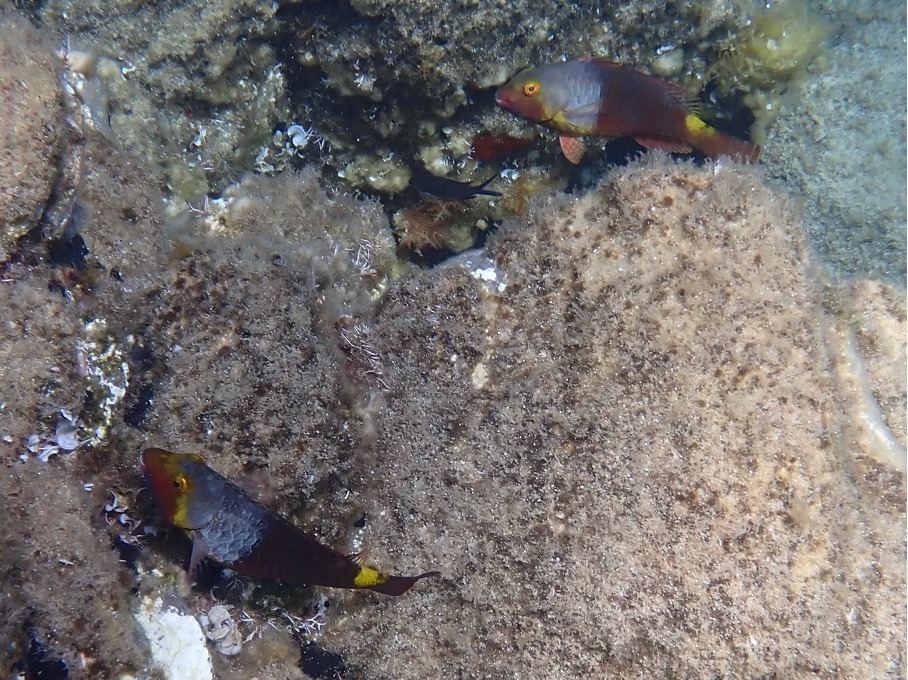
Sparisoma cretense is the only parrotfish in the Mediterranean.
Its teeth, fused together, form a white ‘beak’ allowing to feed on algae and encrusting animals by scraping rocks. These fishes live in small groups on rocky bottoms up to 50 m deep. Their size reaches 30 to 50 cm, the males being the largest. All individuals have very large scales, clearly visible on their sides.
Females are very colourful: their bodies are pinkish to bright red with a large gray patch on the back of the head; each eye is ringed in yellow or even crossed by a yellow band which extends up to below the pectoral fins. A yellow band also surrounds the base of the caudal fin.
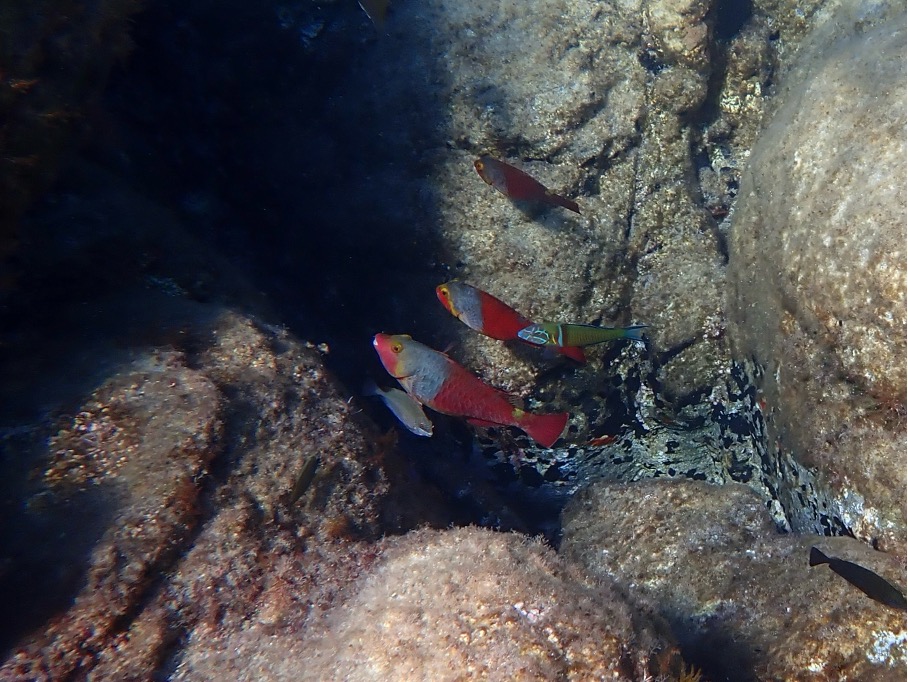
Males are duller, bluish gray with a black spot behind the operculum (see picture below).
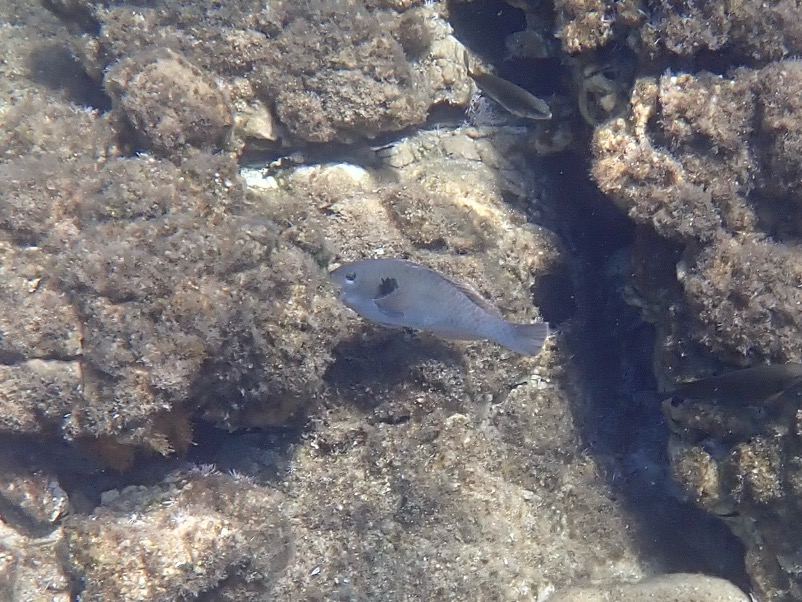
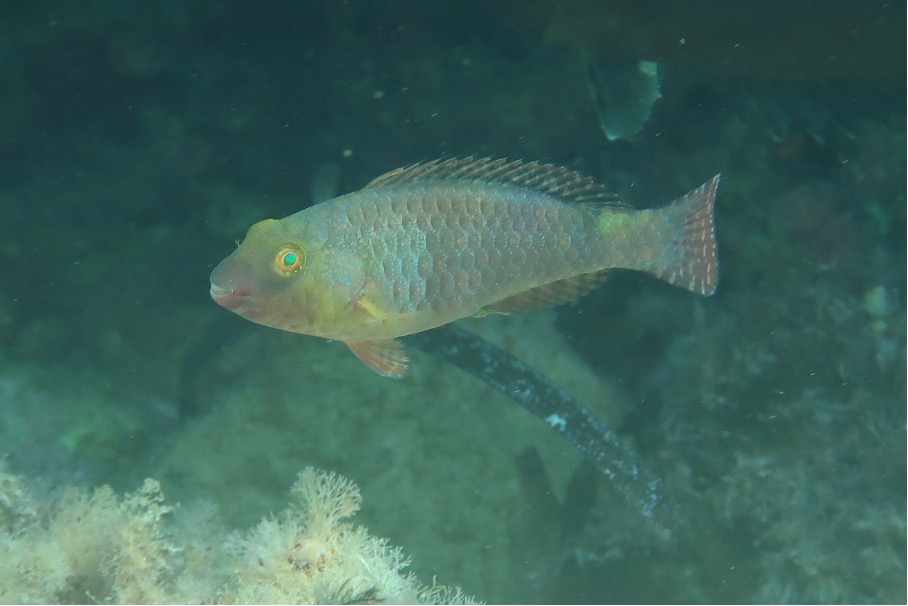
Juveniles are gray to mottled with black or brown; they gradually take on the colour of adults as they grow (see above picture).
Reproduction. Males are rather solitary and territorial while females and juveniles live in small groups. Sparisoma cretense is a gonochoric species (separate sexes), which is surprising because the majority of Scaridae change sex during their life, first being female then male (protogynous hermaphrodites). Breeding takes place in summer (July to September). It takes place either within a harem where a few females are ‘guarded’ by a male or through chances encounters between groups of males and females. Gametes released in the water are fertilized and further development (from eggs to larvae) takes place in open water.
Geographic distribution. Mediterranean (mainly the Eastern basin), Eastern Atlantic (from Portugal to Senegal, also including Canary Islands, Cape Verde, Azores and Madeira).
The Ornate wrasse or Turkish wrasse, Thalassoma pavo (Linaeus, 1758) – Labridae


What a fish! It is impossible to miss these flashy colored fish when snorkeling over rocky bottoms or sea-grasses beds… But understanding ‘who is who’ among them is rather complex. Indeed, sex and colors vary in a particular way!
Let’s start the story… Young fish are born female or male. Individuals born females remain female their whole life or transform into ‘Terminal males’. Individuals born males are named ‘Initial male’; they remain ‘Initial male’ their whole life but … some may eventually become ‘Terminal males’. During reproduction (June to October), ‘Terminal males’ choose a territory on a rocky ridge; this territory attracts mature females. Females lay eggs that are rapidly fertilized by the owner of the territory, a ‘Terminal male’! … However, a few ‘Initial males’ may also attempt to discreetly fertilize a few eggs! (NB: Females are hermaphrodite protogynous: they can become male; sex change can be induced by water temperature).
What about the colours… Juveniles are entirely green with a dorsal black spot (left picture below). They will progressively acquire new colours while retaining their dorsal black spot (right picture below).


While growing, females and ‘Initial males’ display similar colours: a yellow orange body marked with 4 to 6 blue transverse bands; rectangular dashes between the transverse bands will steadily appear and the entire body is then heavily transversally striated. The head is brown to mauve, orange ventrally, with reticulated blue lines.
Above, the two pictures illustrate a group of young individuals (Female or ‘Initial male’).
Adult females are illustrated in the two pictures below.


‘Terminal males’ (see pictures below) are more uniform, greenish and slightly streaked with orange red transversely. Behind their head, there are two (to three) broad contrasted blue and red bands. The head is pinkish-mauve reticulated with blue, like in female.


While undergoing their transformation into ‘Terminal males’, the fish harbours Intermediate colorations (see picture below)

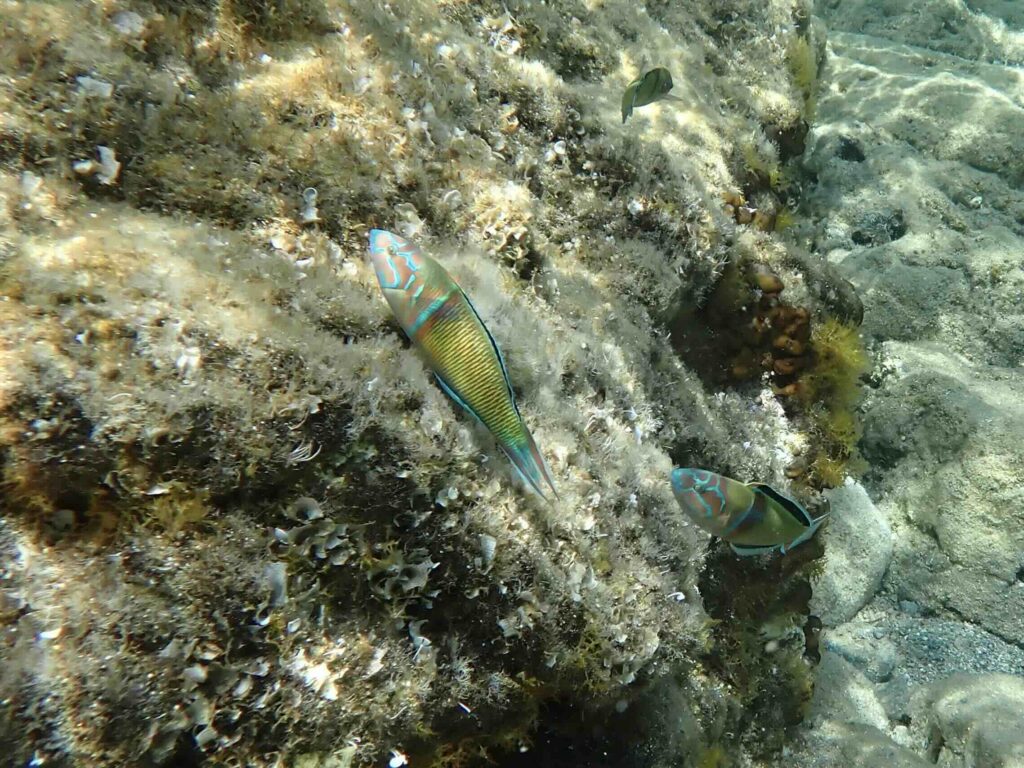
Males are pursuing each others during mating (above picture)
The two pictures below illustrate aspects of the mating behaviour when several females are attracted in the territory of a ‘Terminal male’.


Other features. Elongated fish, the dorsal fin lines the back, the caudal fin has a lyre-like appearance in males owing to longer marginal rays. The head is rather small, with a pointed snout, the mouth has thick lips. Size up to 20 cm. Usually observed between 0 to 20 deep, it can reach deeper waters (150 m). It actively swim over the substrate in search for food. Carnivorous, it feeds on small invertebrates (crustaceans, worms, mollusks, occasionally on sponges); large individuals also feed on sea urchins (Paracentrotus lividus, Arbacia lixula).
It is a thermophile fish preferring water exceeding 25°C. It can burrow in the sediment at night, a way to avoid predators and lowering temperatures.
Geographic distribution. Warm regions of Mediterranean Sea, East Atlantic Ocean from Portugal to Gabon; also in Azores, Madeira, the Canary Islands, Sao Tome and Annóbon.
The Rainbow wrasse, Coris julis (Linnaeus, 1758) – Labridae

Coris julis lives on rock/sandy bottoms, and on sea grass beds, at standard depths range of 0 to 50 m (extreme: up to 120 m). They bury in sand at sunset and to reemerge at sunrise. They are carnivorous and feed on small crustaceans (isopods, amphipods), mollusks, worms and sea urchins. Often seen in small groups when foraging for food. Young individuals may adopt a cleaning behaviour towards other fish, removing small parasites from their skin.
Reproduction. It is a hermaphrodite protogynous: individuals are first female that when reaching ca. 18 cm in length become male (max length of male: 25 cm). Harems with dominant male and several females are observed; if the dominant male dies, an old female will replace it. Reproduction occurs in April-September, fecundation often close to the surface, eggs and larvae are pelagic.


Morphology and colours. Elongated body, rather cylindrical, head with a marked snout. Scales are lacking on the head and at the dorsal fin basis. A layer of thick mucus may coat part of the body. Colors vary with gender. Females have a brown back, underlined by a long white or yellowish-orange horizontal band on their flanks (see the three pictures above). Males have a green back, a longitudinal orange zigzagging band on their flanks and a black mark behind their pectoral fin (see the four pictures below). During the sex change (‘female -> male’), individuals display intermediate colours.


Geographic distribution. Mediterranean Sea, East Atlantic (from Gabon up to Scotland and Norway), including Canaries, Azores, and Cape Verde Islands