Hiding in crevices, overhangs on rocky bottom or among seagrasses
The cardinal fish, Apogon imberbis (Linnaeus, 1758) – Apogonidae
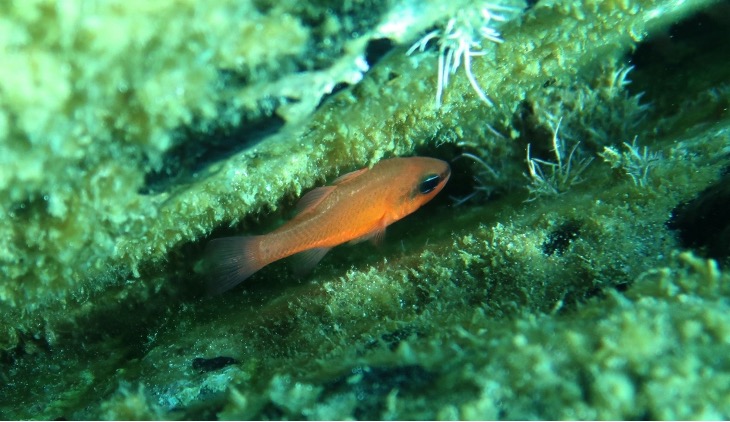
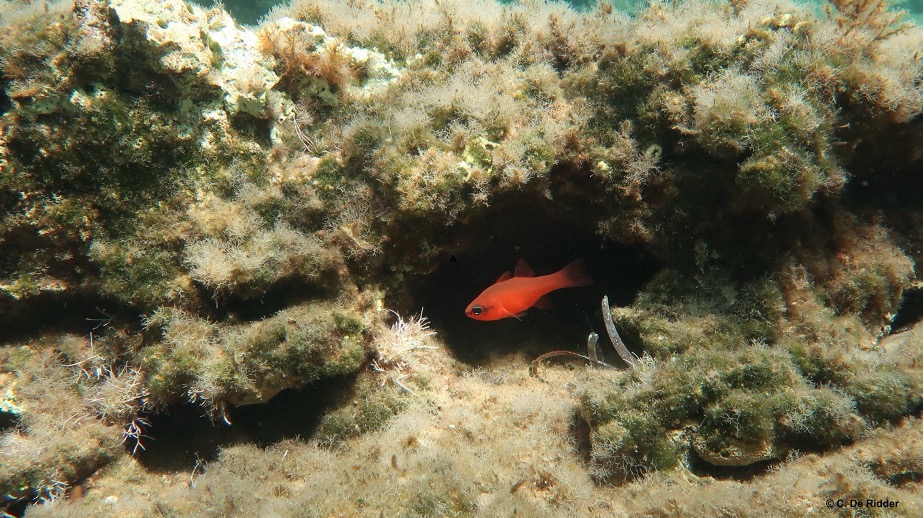
Apogon imberbis (Linnaeus 1758) is a pretty orange-red fish, with large black eyes barred with two iridescent white horizontal streaks. It can reach 15 cm in length but is often smaller (less than 10 cm). Nocturnal, it is wary and hides under overhangs, or in rocky crevices (or even deeper, at the entrance to caves or near wrecks lying on the sea bottom). It feeds on small fishes and invertebrates. Its bathymetric distribution varies according to the seasons (2 to 50 meters in summer, up to 200 meters the rest of the year).
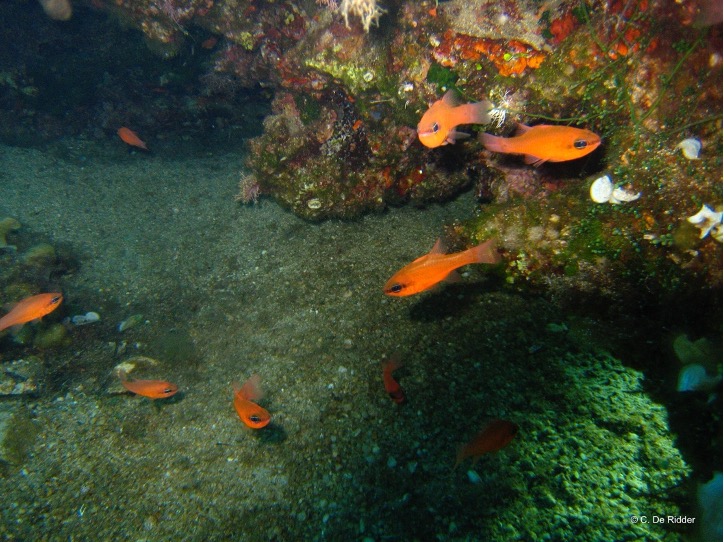
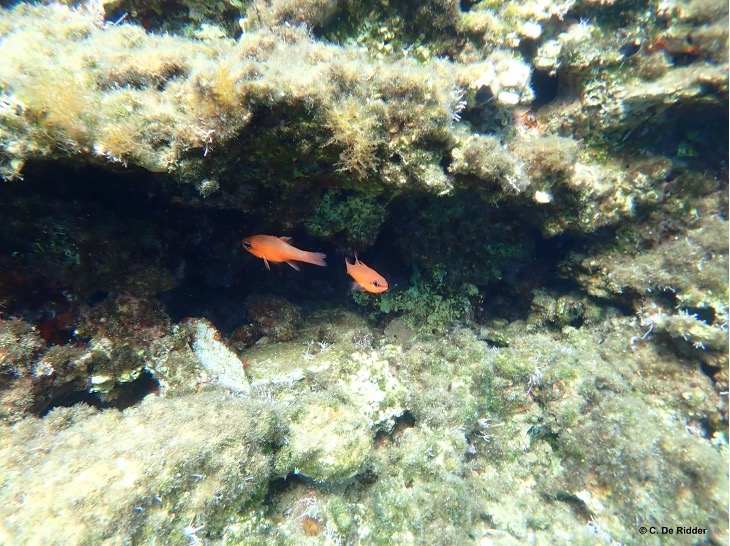
Reproduction is very peculiar! Apogon breeds in late spring and summer. The female is fertilized during a courtship display, and a few days after mating, she lays up to 20,000 embryonated eggs which coalesce into a gelatinous pellet. The male then grabs this amalgam in the mouth, spits it out, takes it again, several times successively to compact it. It will then keep it in the oral cavity for almost a week (oral incubation), will stop feeding and ensure the oxygenation of the eggs (water circulation induced by the jerky movements of the opercula).
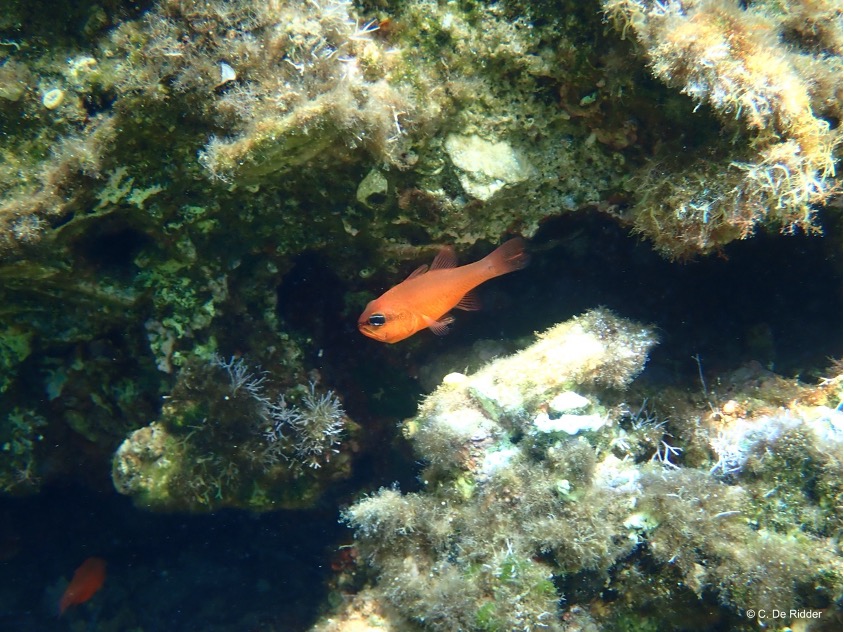
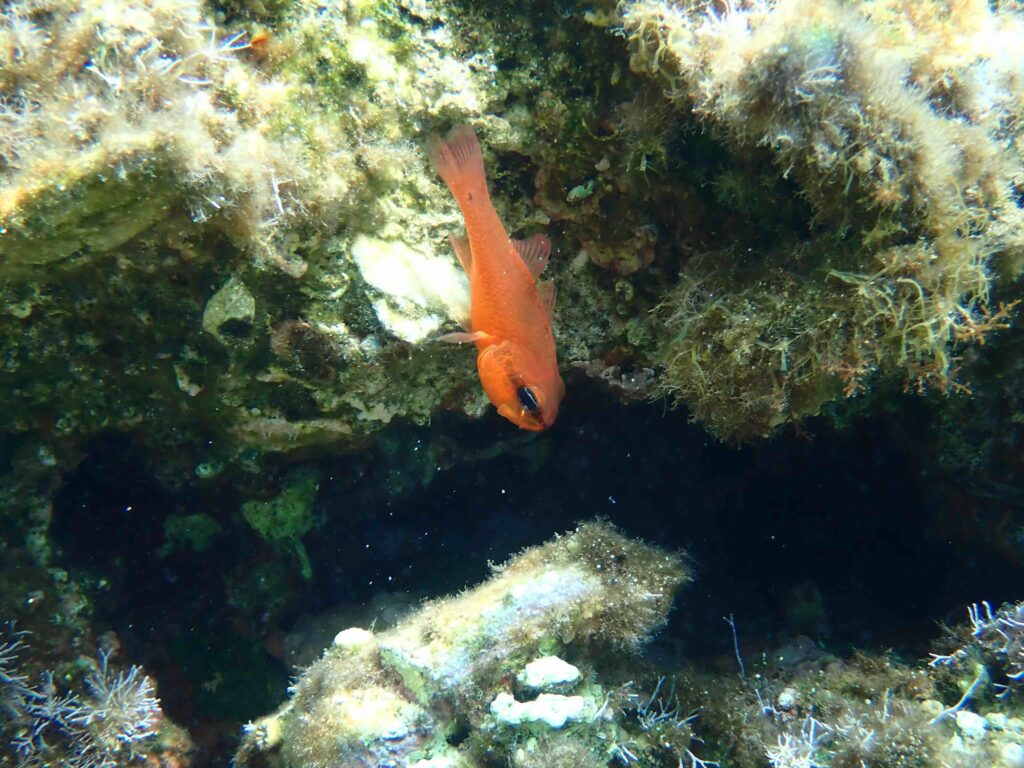
During this period, males and females are easy to recognize because the male’s oral cavity is deformed (his head is then stocky, his lower jaw prominent… which gives him the appearance of a bulldog!). Upon hatching, the larvae leave the oral cavity for the open water. The male can repeat this incubation behavior almost four times with different females… but successive fasting can cause him to die of starvation.
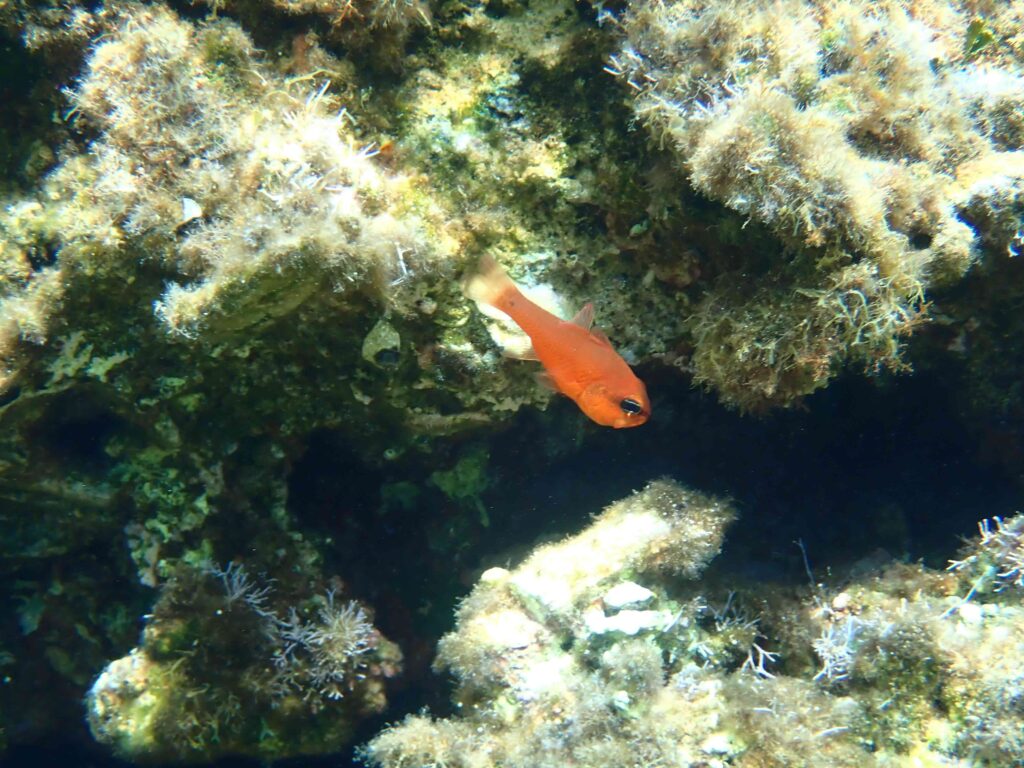
Geographic distribution. Mediterranean, Eastern Atlantic from the south of the Bay of Biscay up to the Gulf of Guinea; Azores, Cape Verde and Canaries Islands
The lettered perch or painted comber, Serranus scriba (Linnaeus 1758) – Serranidae
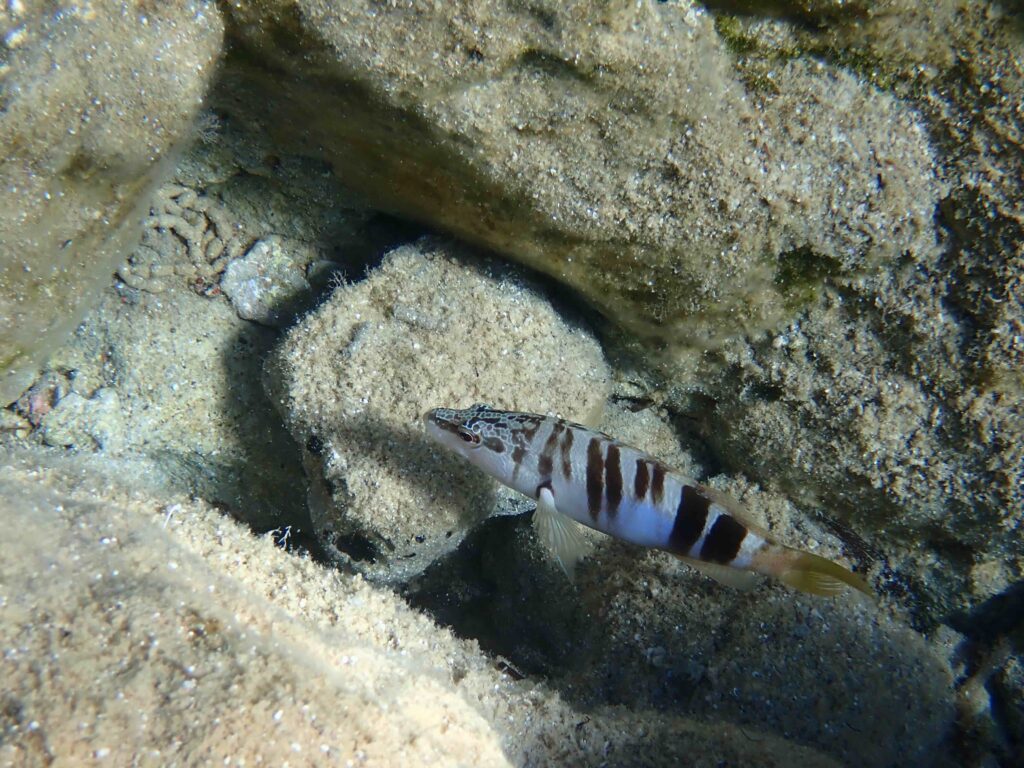
The body is laterally compressed, robust, moderately elongated, with a pointed snout and a powerful truncated caudal fin (broad caudal peduncle). The head has a prominent lower jaw. Its protractile jaws elongate when capturing prey. Adults are ca. 20–25 cm long
Serranus scriba is typically colourful. The head is brownish in its dorsolateral part and pale, yellowish – greenish in its lower part, below the eyes. The head is typically adorned with light gray convolutions reminiscent of written inscriptions (hence its name lettered perch).
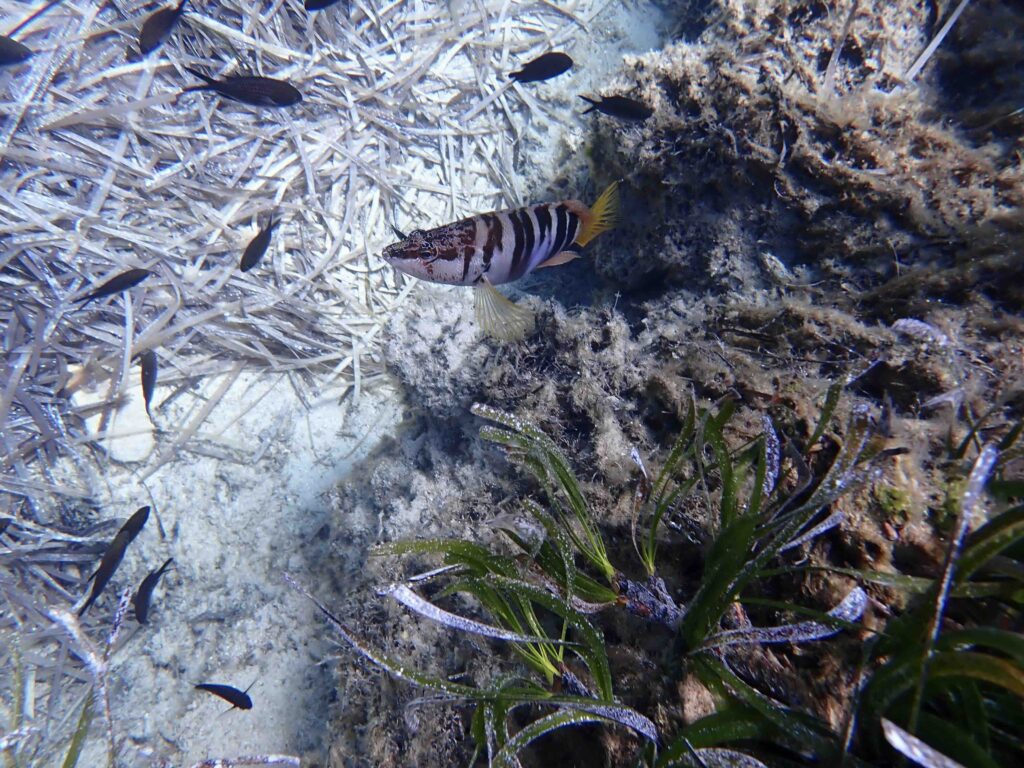
Its flanks are whitish to bluish with 5 to 8 vertical black or brownish stripes; these stripes are large dorsally and thin ventrally; their pattern extends onto the dorsal fin. The flanks bear a bluish patch, mostly posterior and ventral. Caudal peduncle and fin are yellow. The pectoral, ventral, and anal fins are translucent yellowish. The dorsal fin is rather uniform in size along the entire body with 8 or 9 anterior spines; it is generally folded back when the fish is quiet.
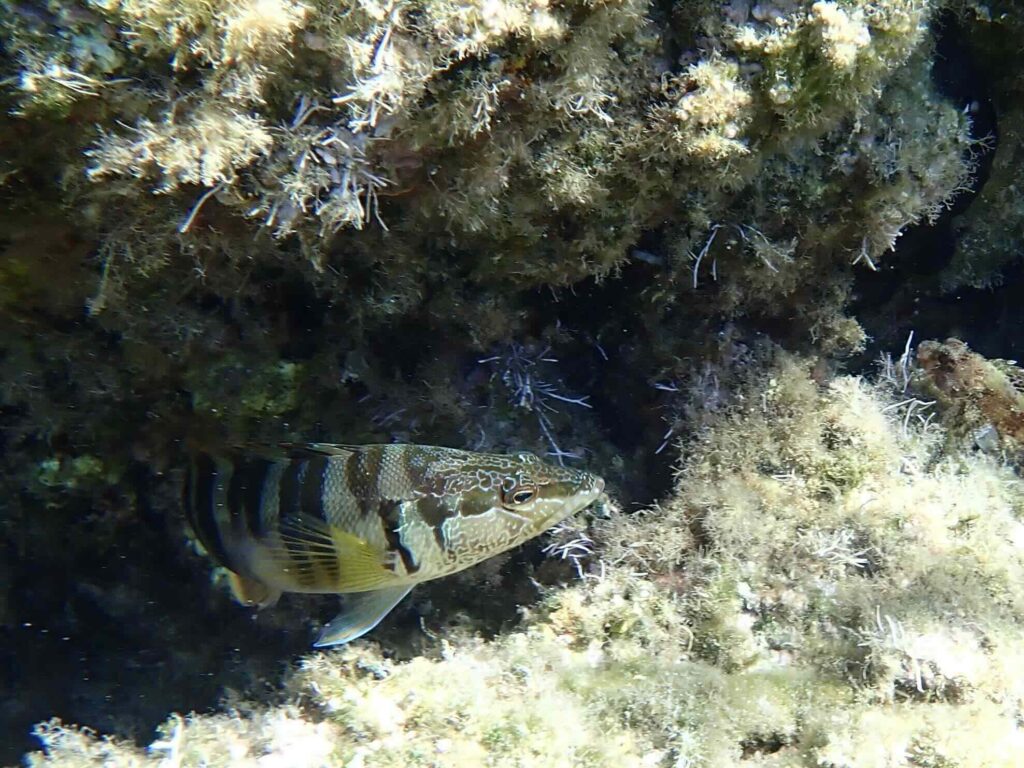
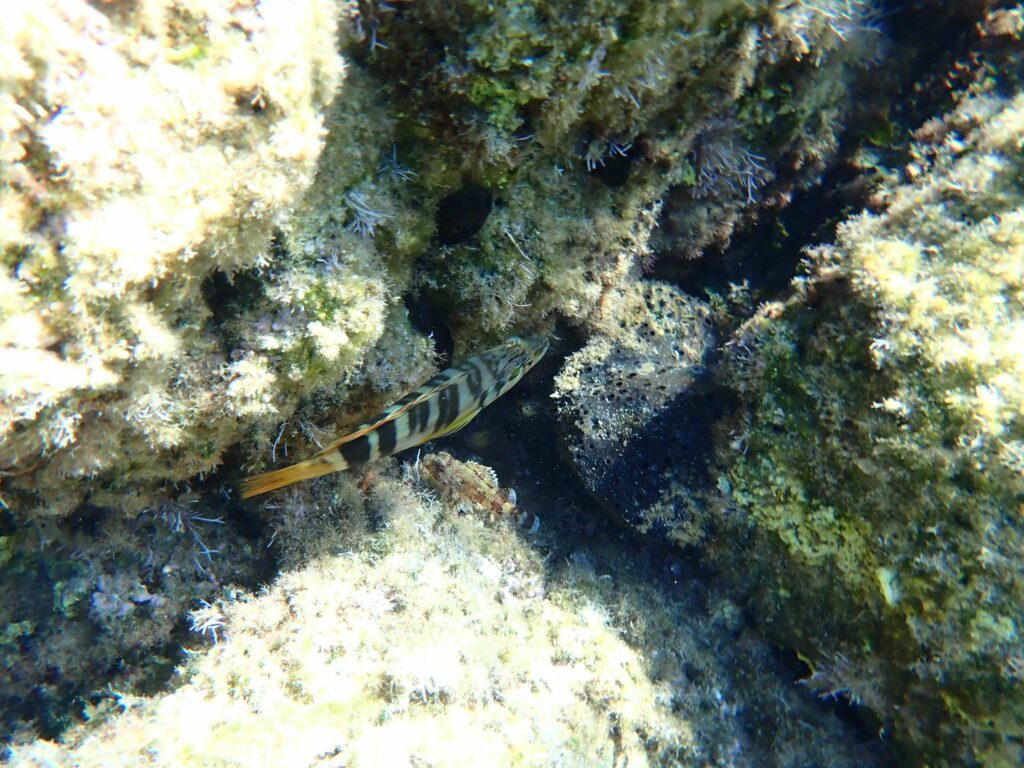
It is a solitary and territorial fish that lives near the bottom. It spends the day sheltering in rocky areas and/or near Posidonia beds; I often saw this species staying in wait under overhangs or in cavities, or on the edges of Posidonia rhizomes. It is however curious and may stare at you staying quite close.
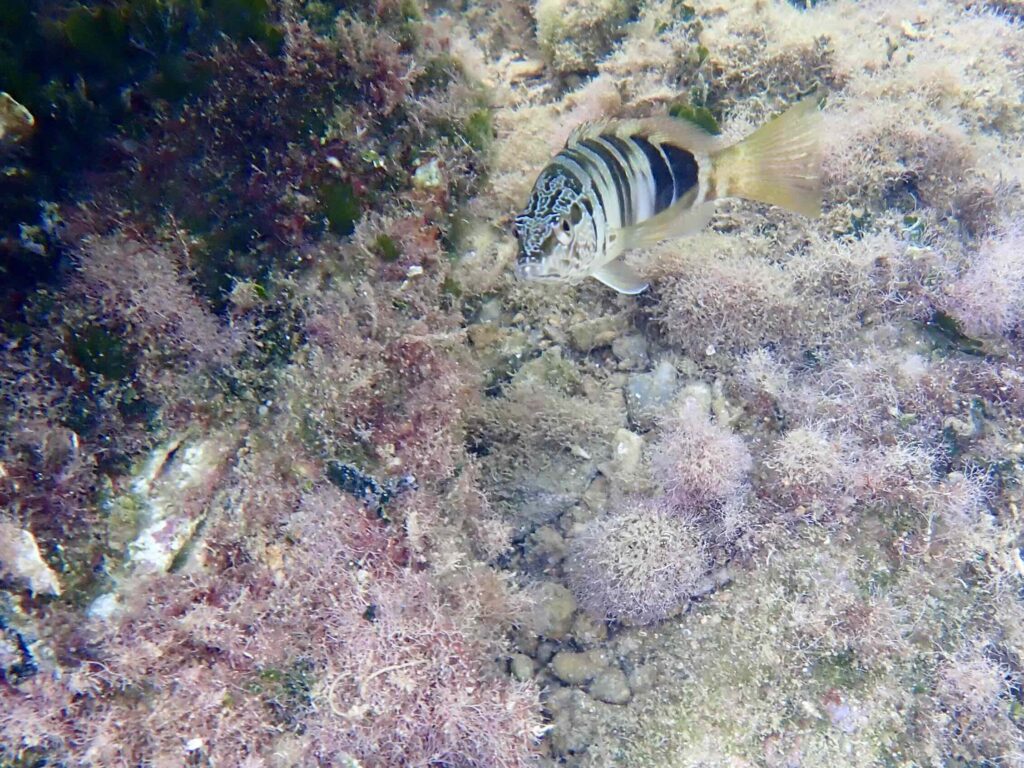
I’ve also regularly observed it near an octopus, probably waiting to feed on the remains of the octopus’s meal! (see pictures below)
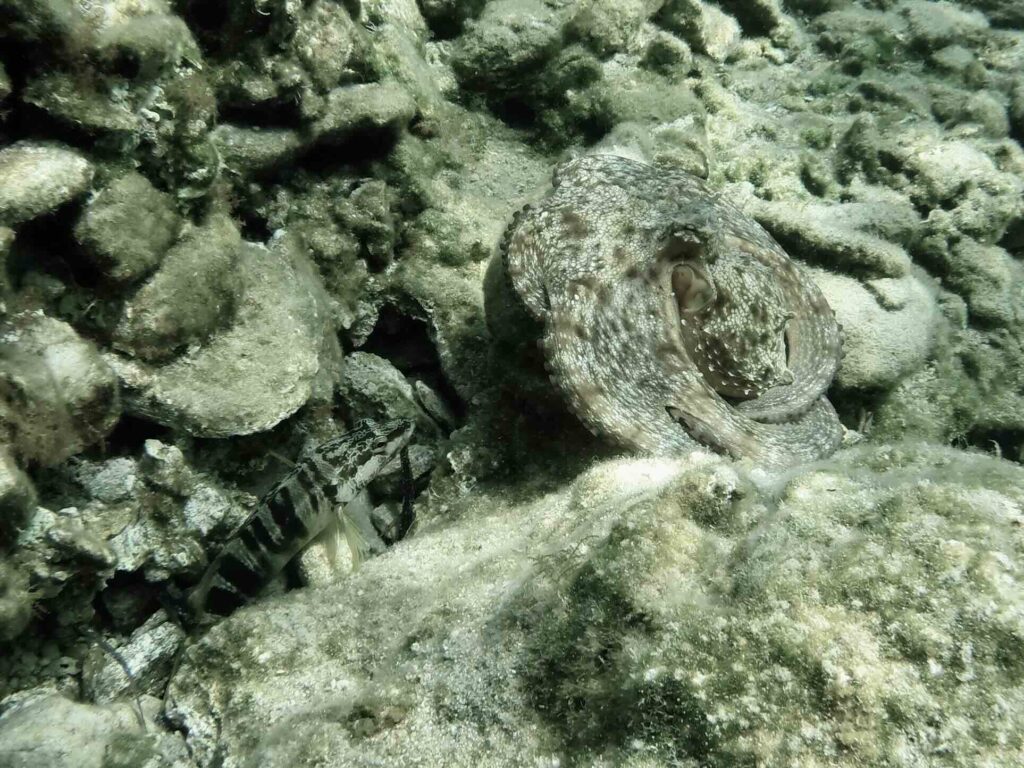
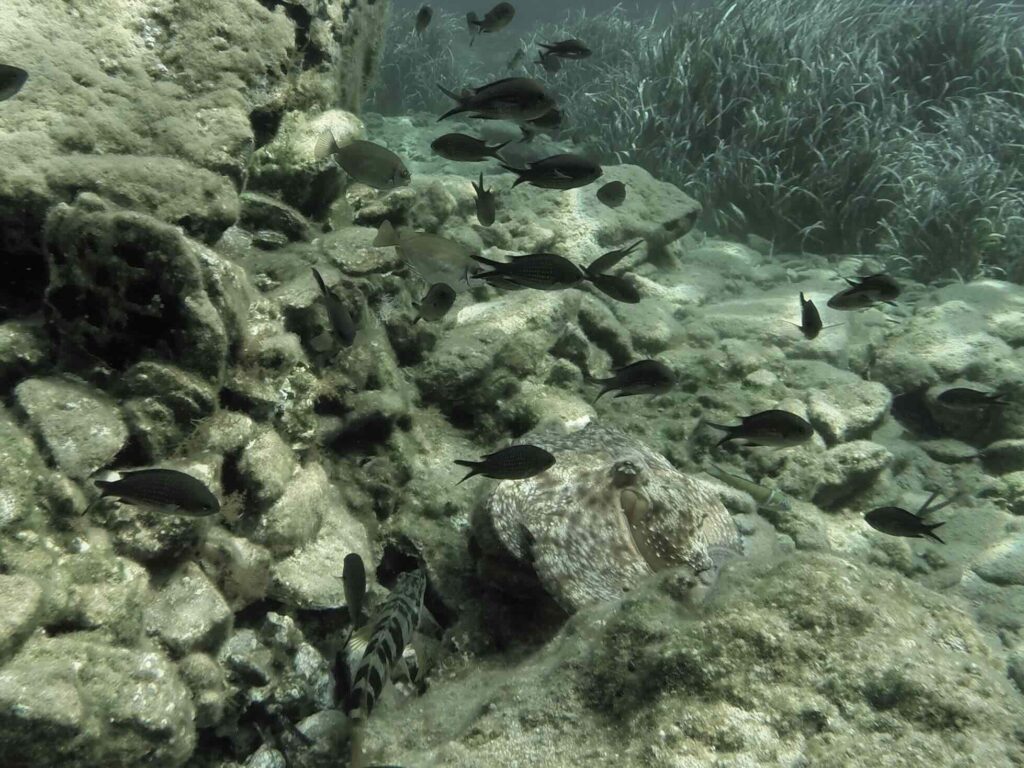
Benthic, territorial, and predatory, this carnivore hunts by lying in wait, quickly charging toward its prey (fish, cephalopod mollusks, crustaceans, and worms).
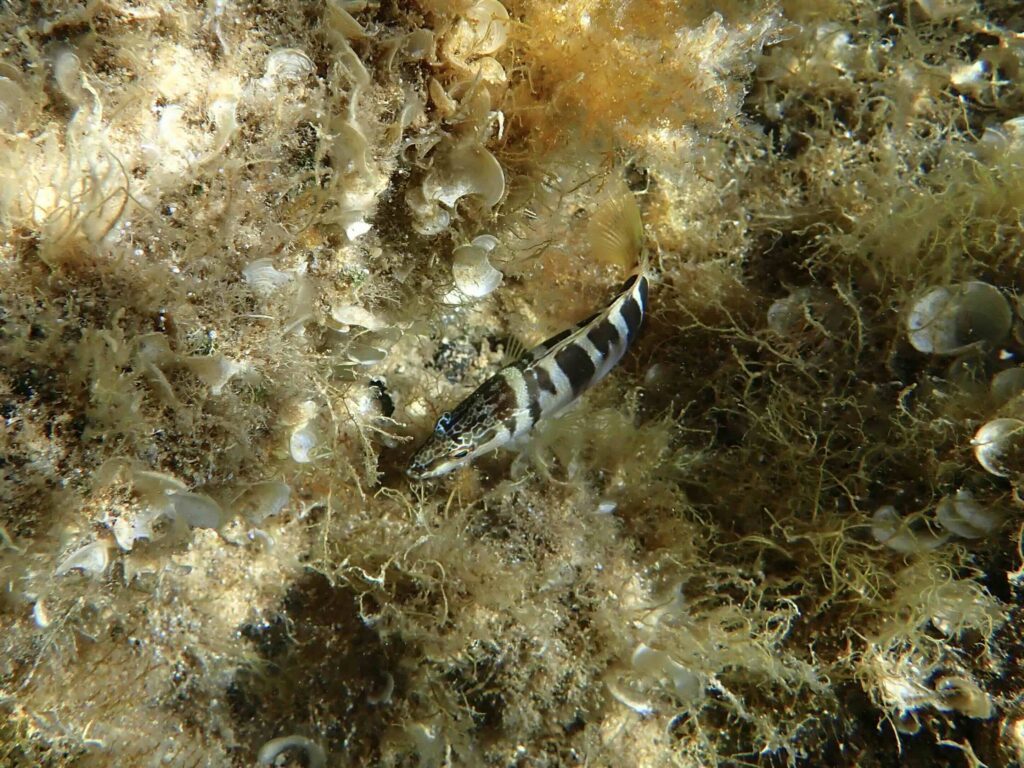
Reproduction. It is a synchronous hermaphrodite; its gonads consist of a male and a female part (ovotestis) that can be simultaneously functional, with the possibility of self-fertilization. Reproduction from April to September; the eggs are stuck to stones
Geographic distribution. Mediterranean Sea, Black Sea, the eastern Atlantic coast (from the Bay of Biscay to southern Mauritania); Madeira, Azores and Canary Islands
The comber or the gaper, Serranus cabrilla (Linnaeus 1758) – Serranidae
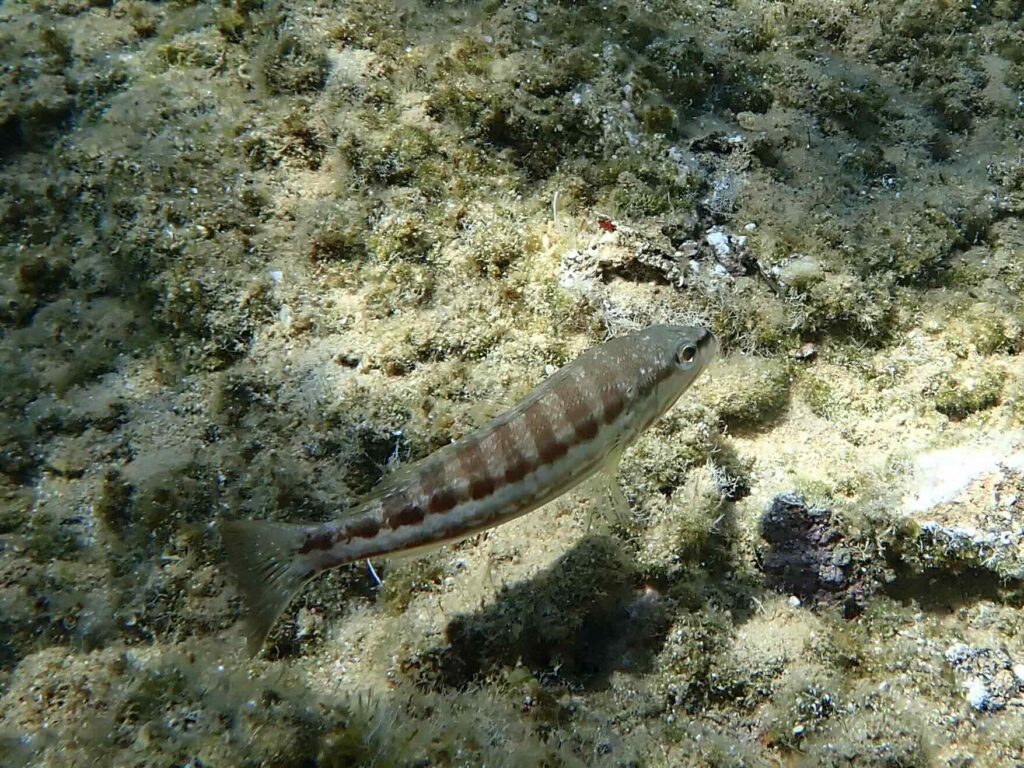
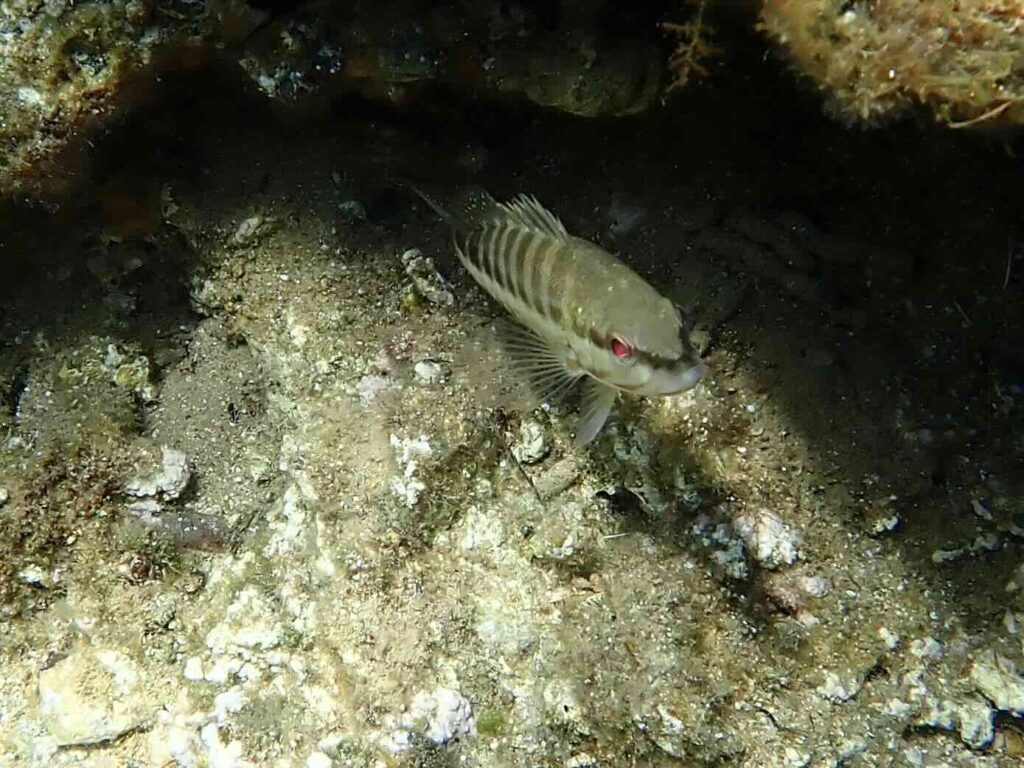
The body is elongated, slightly compressed. Adults are ca. 10–15 cm long (can reach up to 40 cm).
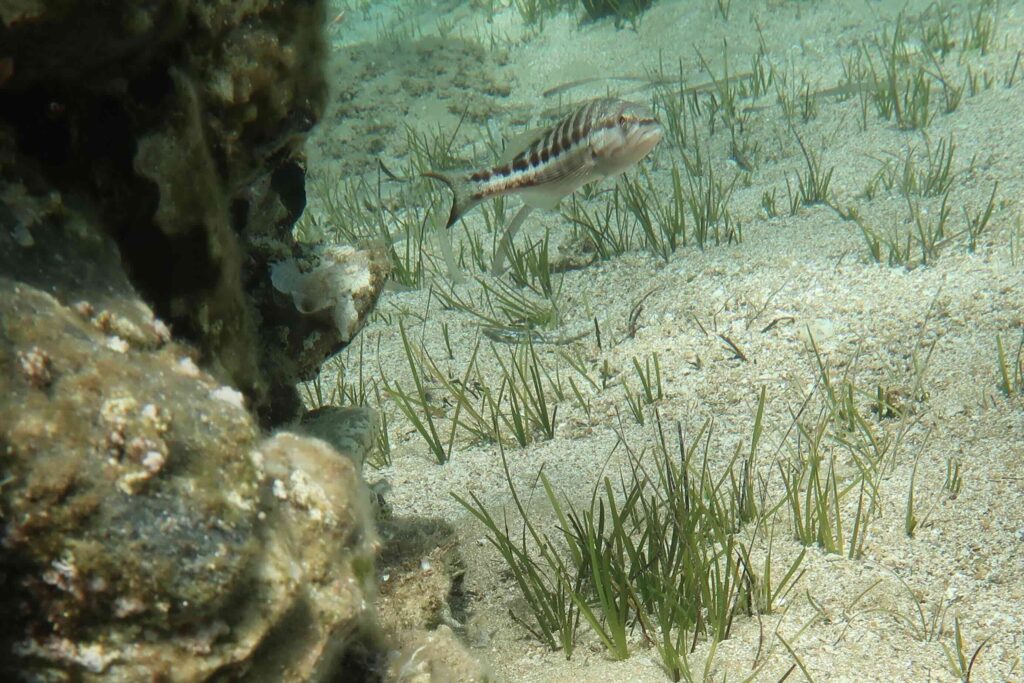
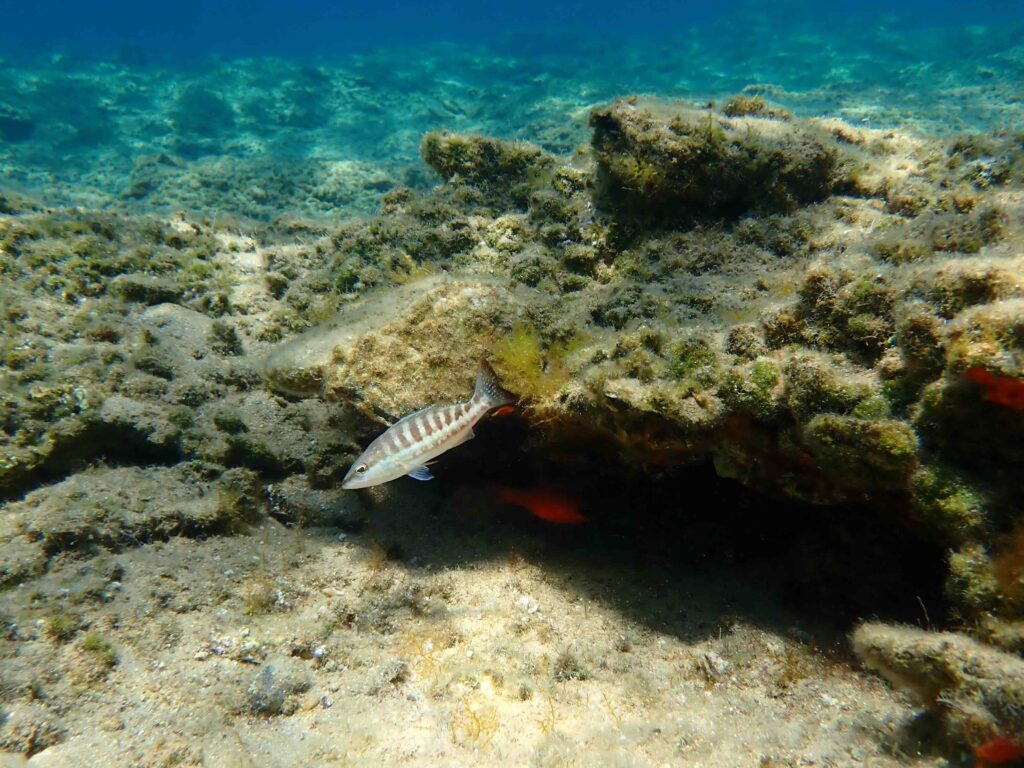
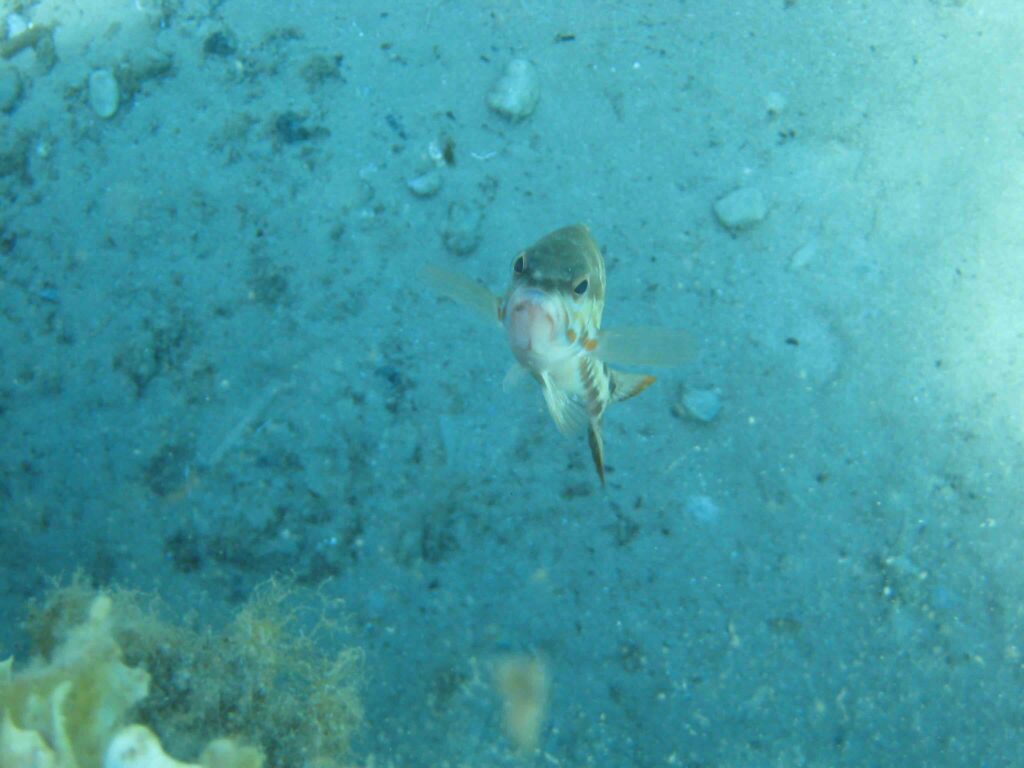
Its colour varies according to several factors (age, sex, habitat and emotional state). Frequent coloration: a whitish horizontal line in the middle of each flank and 7-9 vertical brownish bars; a brown horizontal line may also occur parallelly to the white one, prolonging to the snout passing over the eyes and joining into a V shape. This line gives a particular look to the fish when it is facing you! Cheek with 2 to 3 oblique reddish-yellow to brown bars. Fins are rather translucid, with little lines of bright, pale purple spots.
Dorsal fin with spines anteriorly. The caudal fin is rounded, usually with a brownish posterior margin. The head has a prominent lower jaw with protractile jaws, elongating when capturing prey.
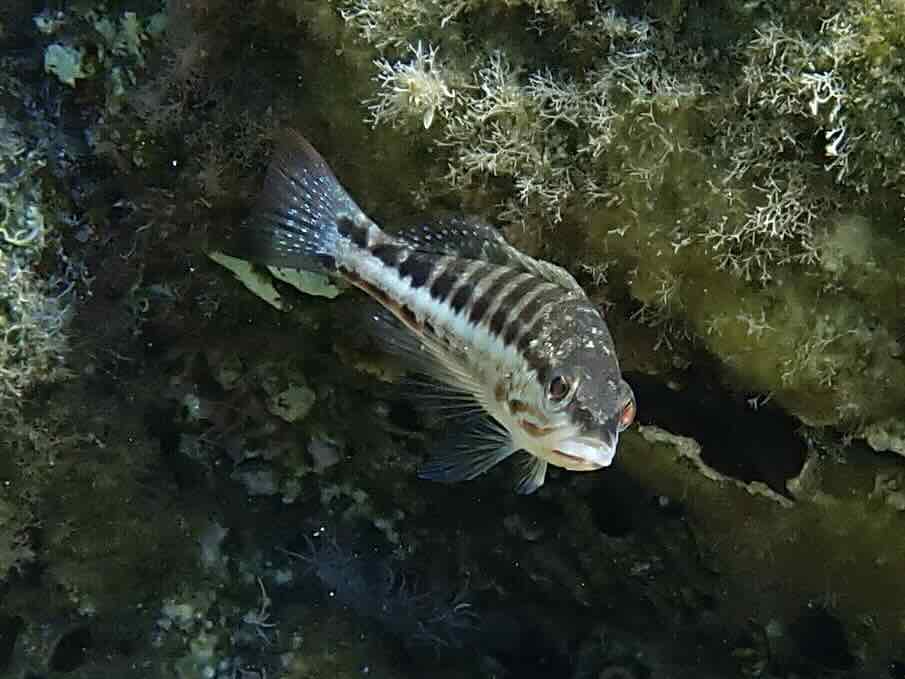
Rather solitary, the comber is living close to the sea floor, usually on rocky bottoms. This carnivorous fish hunts from a stalking position and catch small preys like crustaceans, fishes or cephalopods.
Territorial, it often comes straight to you, ‘severely’ looking at the intruder with its large prominent eyes. It is a regular encounter when you stay immobile taking a picture!
Reproduction. It is a synchronous hermaphrodite; its gonads consist of a male and a female part (ovotestis) that can be simultaneously functional. Reproduction from March to August, the eggs are stuck to stones.
Geographic distribution. Mediterranean Sea, Black Sea, the eastern Atlantic coast (from the English Channel to Cape of Good Hope); Madeira, Azores and Canary Islands.
Ectoparasite. The comber, like many other fish can be parasitised by Anilocra (size: 1-5 cm long) – see the picture below.
Anilocra Leech 1818 is a crustacean, it belongs to the order Isopoda and to the family Cymothoidae .
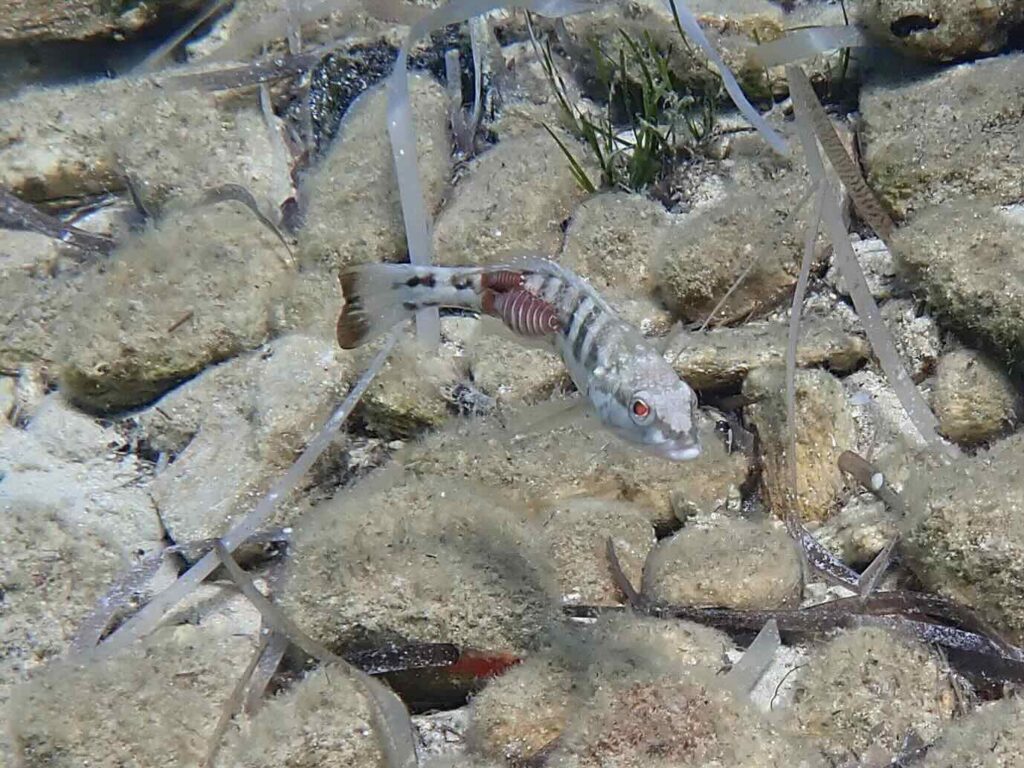
Anilocra are ectoparasites of marine fish, they attach to their hosts with the sharp claws ending their legs. They occur on the head of the fish behind the eyes, on the flanks or at the basis of the caudal fin. They feed on the blood of fish, but also on mucus and skin tissue. Their lifespan is usually 1-2 years.
The parasitised fish weakens and becomes more vulnerable to predators (this weakening is seen in the picture: the host is carrying here a male and a female Anilocra)
The reproductive cycle of Anilocra is particular: while on their host fish, the adult is initially male and later, female (protandrous species). Female exerts an inhibitory effect on male, forcing it to remain male. However, when the female dies, the male transforms into a female as the sex inhibition stops. Females are therefore always the oldest and largest individuals on the host body (as illustrated on the above picture). Mating is unknown. Female incubates eggs in a ventral pouch (marsupium). Fertilized eggs develop into larvae that are released in the surrounding water. Juveniles are free until they attach to a new host where they will grow as male.
The grouper, the dusky grouper, the yellow belly rock cod or the yellow belly grouper, Epinephelus marginatus (Lowe 1834) – Serranidae
I only observed young individuals (15-20 cm), fearful, hiding among rocks, overhangs in relatively shallow water (2-5 m deep). Their body is massive, dark green to grey, mottled with light green, yellowish to whitish roundish marks. There is one dorsal fin, it occurs along most of the body length. The caudal fin is rounded and short. The head is expressive with its large mouth bordered by thick lips and with its very prominent eyes ornated by a conspicuous whitish-greenish spot on their upper edge.
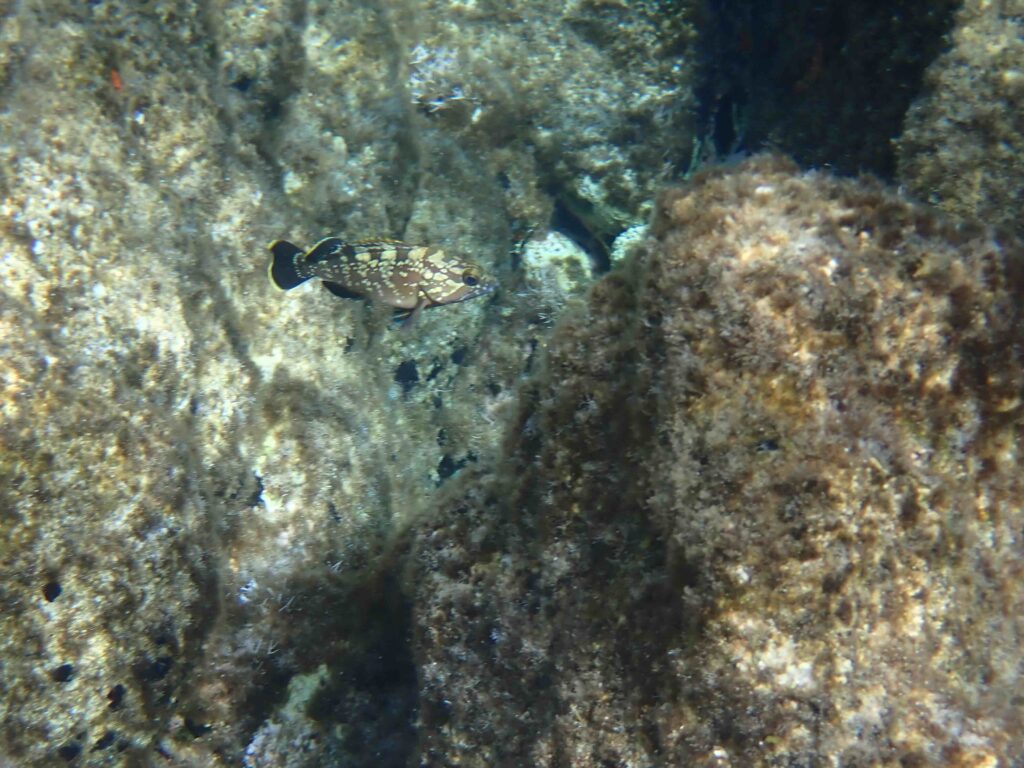
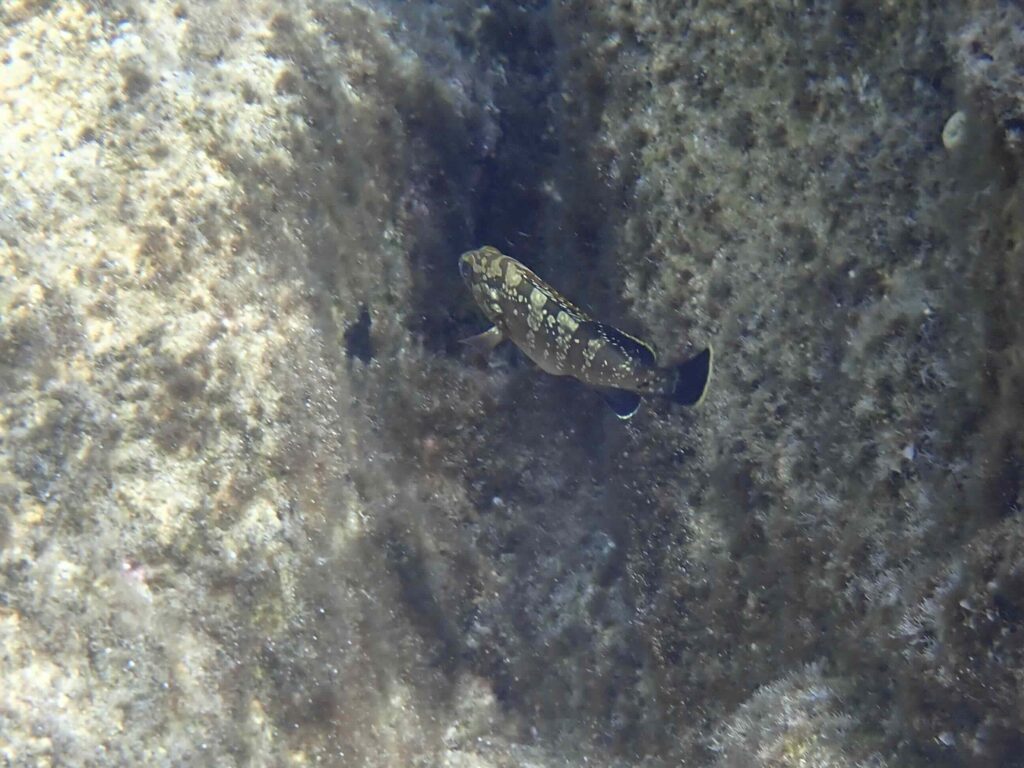
NB: I never met adult individuals; these are demersal fish living to depths up to 400 m and are among the largest fish (up to 140 cm and 65 kg) met by divers in the Mediterranean. The colors of adults differ from that of the juveniles by being darker, usually reddish to brown or grey with clear marks, and showing variations according to mood or stress. The color pattern is specific to individual.
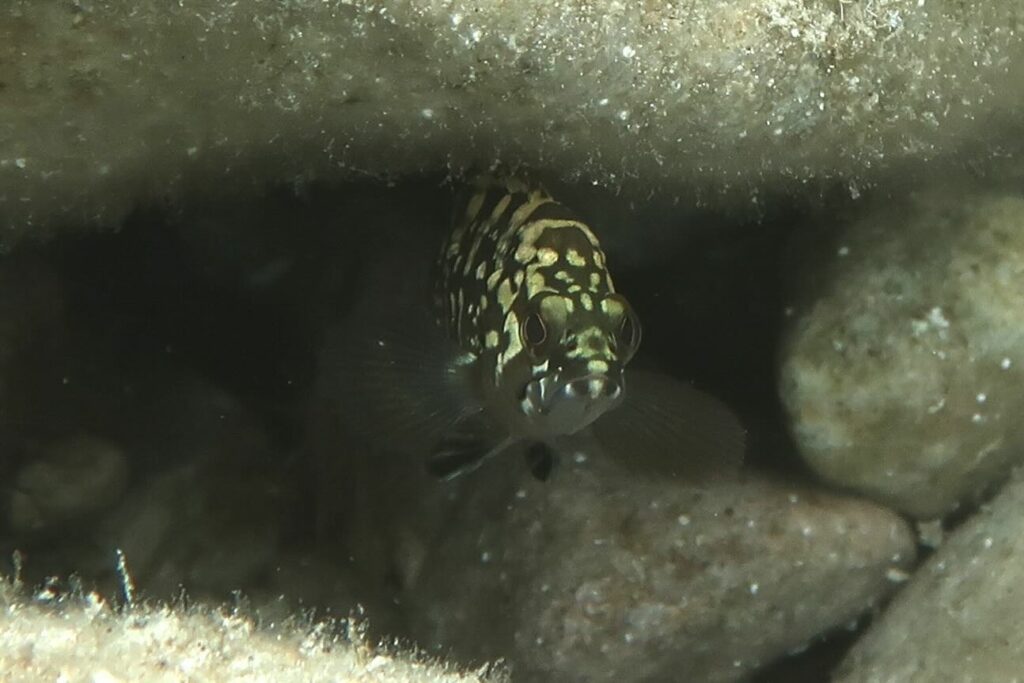
It is a solitary and territorial fish that feed on fish, crustaceans, and cephalopod mollusks (squid, cuttle fish, octopus). It hunts by lying in wait. The regime changes with age. Youngs initially feed on small crustaceans (isopods, amphipods, shrimp), and later, on crabs. When their size reaches 20 to 60 cm, they feed on crabs and fish, and when over 30 cm long they start to feed also on cephalopod mollusks. The largest groupers (> 60 cm) mainly feed on cephalopods and fish.
Reproduction. Hermaphrodite, protogynous fish. First female, it develops into male when older and larger, probably around 9 to 13 years old (ca. 65-90 cm long). The oldest individuals reach ca. 60 years. Females begin to breed when ca. 5 years old. Breeding occurs in spawning sites, from June to September in the Mediterranean. Gametes are released in the water column where fecundation occurs; the larvae hatch after about 40 hours.
All the individuals I met were thus females!
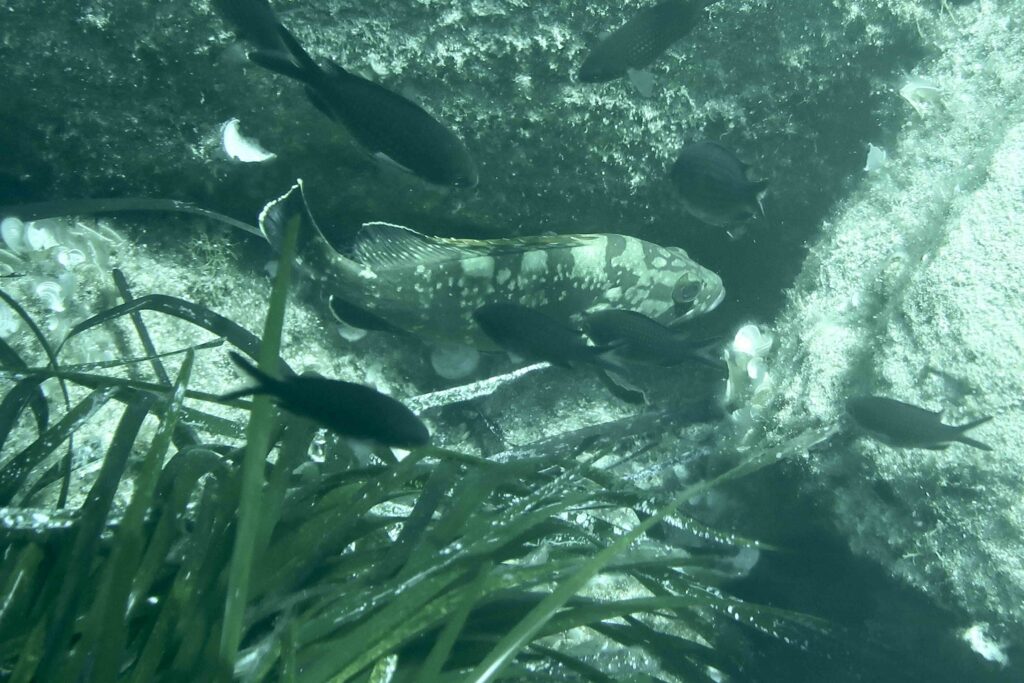
Geographic distribution. Mediterranean and Eastern Atlantic from southern Brittany to South Africa from where it extends to the SW Indian Ocean (Mozambique) ; Rare north of the Bay of Biscay.

Epinephelus marginatus is classified among the vulnerable species by the International Union for Conservation of Nature (IUCN).
The moray-eel or the Mediterranean moray, Muraena helena Linnaeus 1758 – Muraenidae
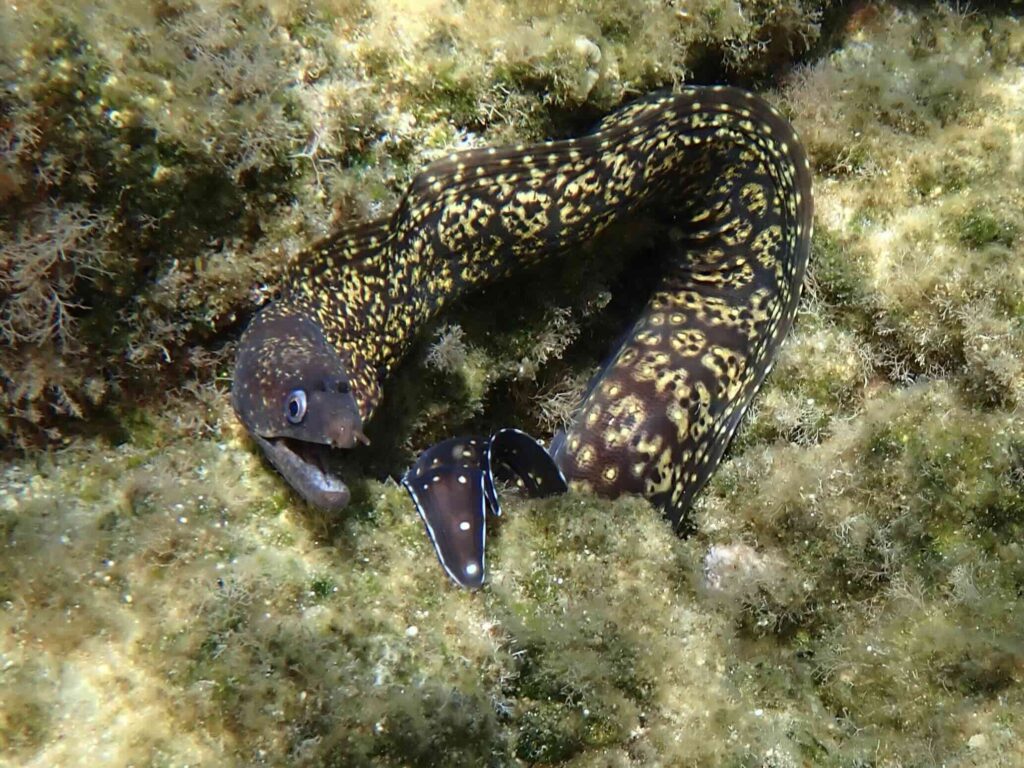
Moray-eel has an aggressive appearance … its eyes are large and strangely fixing you, the mouth is wide with powerful jaws that bear anteriorly conspicuous long teeth.
The body is elongated and powerful, it can reach 1.50 m in length. It is slightly compressed laterally mainly at the level of the ‘tail’. Pectoral and ventral fins are lacking. Anal, dorsal and caudal fins are fused together forming a continuous fin (medio-dorsally and medio-ventrally) along most of the body length. The skin has no scales and secretes a mucus layer. The color is brownish-purple with yellow or whitish circumvolutions.
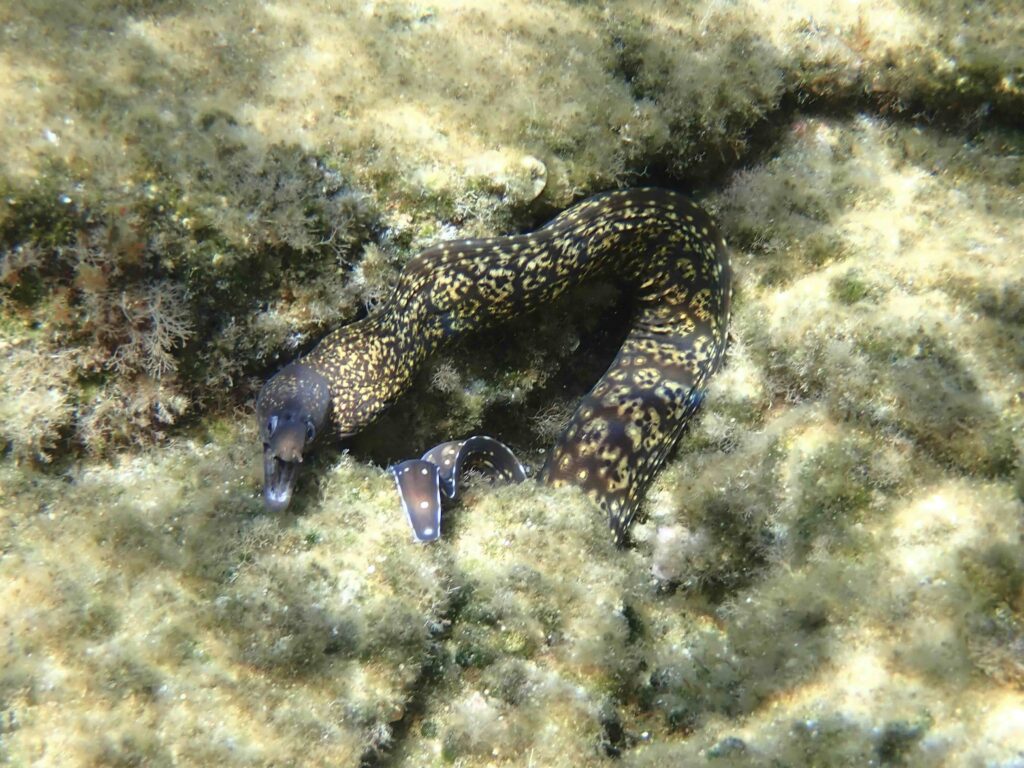
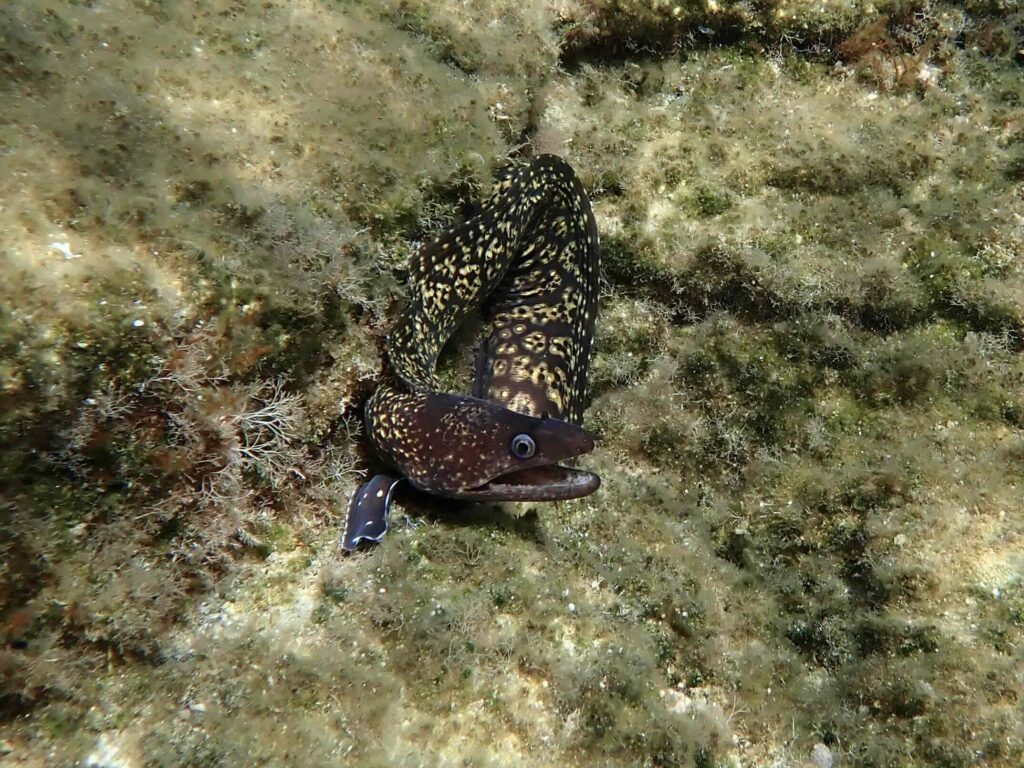
Moray-eel lives on rocky bottoms at depths ranging from ca. 1 to 800 m. It is a territorial and solitary fish that hides in crevices and overhangs; it comes out of hiding when hunting (mainly during night) or when feeling threatened. It hunts by waiting for a prey passing nearby and relies on its developed sense of smell to detect it. It feeds on fish, crabs, cephalopods (octopus, squid, cuttlefish) and may also scavenge on carrion. Occasionally, it can search for food in sea-grass beds.

 Conspicuous tubular nostrils that occur at the extremity of the snout have a crucial role in food detection. Indeed, the moray-eel is almost blind and relies on smell detection to locate its prey. Water is inhaled in the nostrils through ciliary currents and reaches sensitive papillae informing the animal on the presence of a prey.
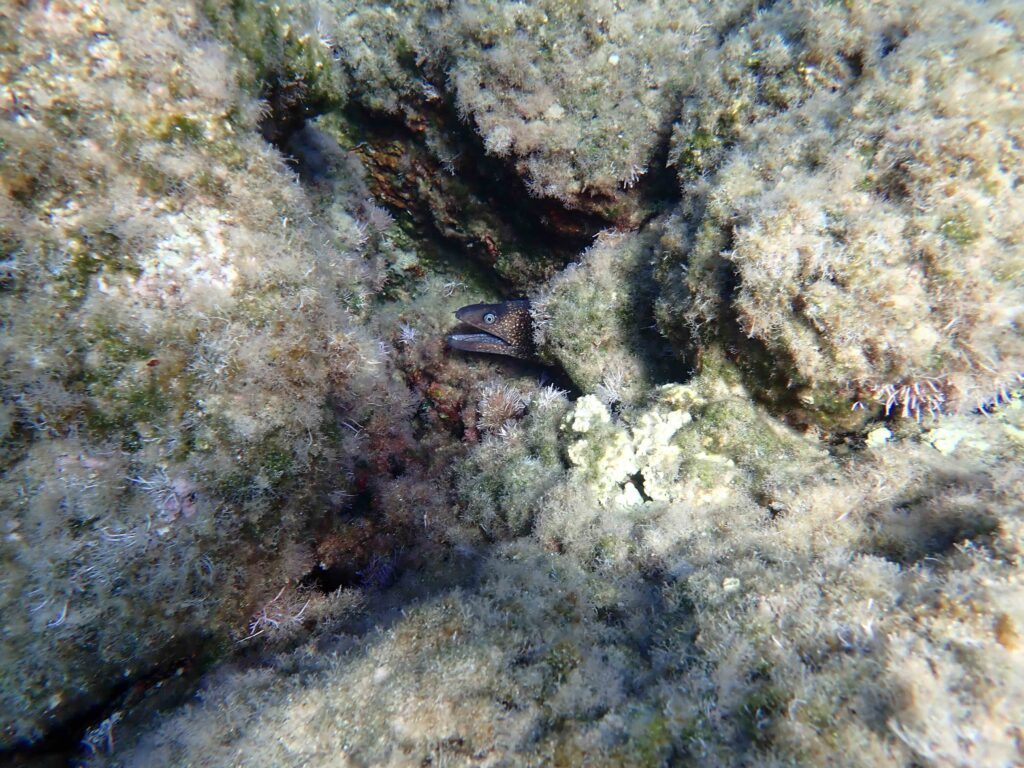
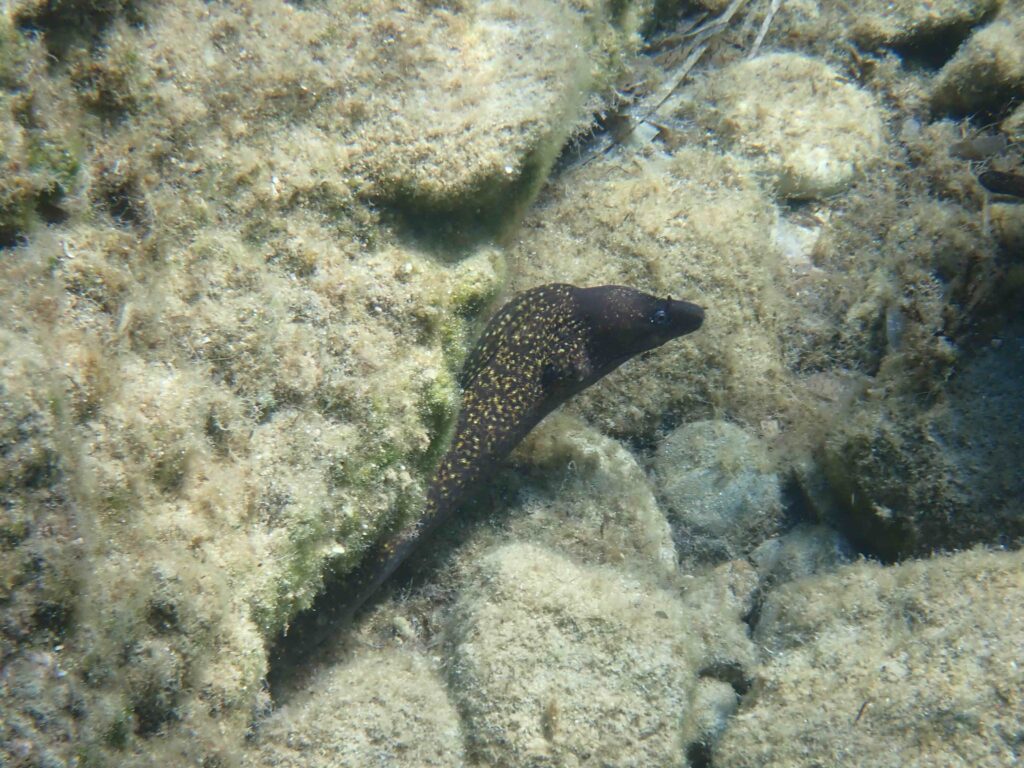
Reproduction. Not well known. It occurs in summer (July-September). Eggs are released in the surrounding and release planktonic larvae that will spend about 1 year in the water column before to migrate towards the sea bottom and become adults.
Geographic distribution. Mediterranean Sea, East Atlantic coasts, from Great Britain up to Senegal; Azores, Cape-Verde and Canary Islands.
The Common Octopus, Octopus vulgaris Cuvier, 1797 – Octopodidae
Octopus are mollusks … Mollusca gathers 7 main taxa (Aplacophora, Polyplacophora, Monoplacophora, Gastropoda, Cephalopoda, Bivalvia, Scaphopoda). Each of them harbors its own morphologies and habits. Detailed comments are provided in scientific books (cf. References).
The basic organization /design of mollusks can be presented in a ‘fictive’ model which is useful to describe morphology and biology of extant mollusks.
The generalized mollusk is a marine benthic animal, having a bilateral symmetry and being depressed dorsoventrally. Basically, the body of the generalized mollusk encompasses an anterior head, usually small, a dorsal visceral mass and a particularly well-developed ventral foot. Dorsally, the body wall is named the mantle. The mantle protects the visceral mass, synthesizes the shell, and forms an inner fold delimitating a posterior cavity, the mantle cavity. The anus, the nephridiopores (excretory orifices), and the gonopores open in this cavity that also harbors the gills. The mantle cavity is in continuity with the surrounding water. Owing to ciliary currents, water enters the cavity, circulates along a precise trajectory, bringing oxygen to the gills and carrying outside wastes and gametes. Although this model shows variations in the different major taxa, it serves as a good tool to explain mollusk basic organization.
Octopus belongs to the Cephalopoda, an ancient taxon that first appears during the Cambrian, ca. 500 MY ago. Cephalopods are highly specialised mollusks, including extant species (Nautilus, cuttlefish, squids, and octopods) and fossils (nautiloids, ammonoids and belemnoids). Most cephalopods are pelagic but bottom dwelling habit has been acquired by the Octopodidae. Cephalopods are carnivorous, and often very active predators. This activity is related to the high development of their nervous and locomotory systems.
Compared to the generalized mollusk model, cephalopods have elongated their dorso-ventral axis, with the head and the foot close to each other, at one end of the body (their name cephalopod means ‘head-foot’). The foot is subdivided into highly mobile tentacles bearing suckers. The foot also forms ventrally at the exit of the mantle cavity, a sort of funnel, the siphon. Water circulates owing to the contractions of the mantle wall. It enters the mantle cavity via a space between the siphon and the body wall and is expelled outside via the siphon. The siphon is mobile and has a narrower opening allowing respectively a directional and a powerful ‘backwards’ displacement (fast jetting). The shell is embedded in the mantle or absent (e.g., Octopodidae), and only Nautilus has an external shell.
Encountering Octopus vulgaris Cuvier, 1797

Living mainly on rocky bottom, it occurs in rather shallow water.
Although its bottom dwelling habits, it is not always easy to see because it is mimetic: its body can rapidly change color and shape according to surrounding and mood, allowing camouflage or communication with other individuals. Color changes are due to chromatophores, i.e., dermal cells that contain pigments. They can contract or expand very rapidly under the control of the nervous system, resulting in almost instantaneous color changes.

The body length is about 25 cm in adults, and the tentacles can reach a meter when extended. The tentacles and their suckers allow to catch preys that are passing by, as crustaceans (crabs, crayfish), or mollusks (bivalves etc..). The mouth has a strong horny beak able to break carapaces and shells. Secretion from a venom gland also allow to subdue the prey.

It's one of my favorite encounter!...
If you stay motionless you can be lucky enough to observe the octopus going on with its business (feeding or consolidating its hiding place) but keeping an eye on you!  However, it can rapidly escape when afraid, usually disappearing in its hiding place or swimming away. In this later case, it can expel a cloud of dark brown or black ink via the anus that puzzles their predators! (ink is secreted by a gland that opens into the rectum).
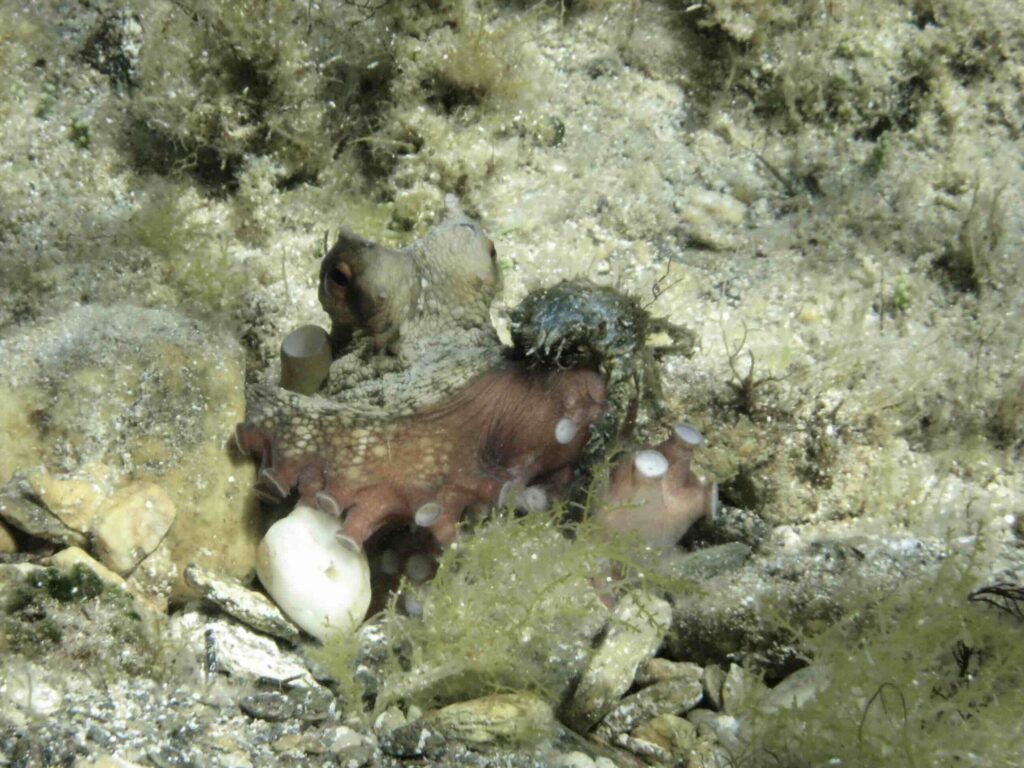
The eyes are very mobile and can erect when observing something more particularly. They have a cornea, an iris, a lens, a retina, and two eyelids, the pupil is slit-shaped.

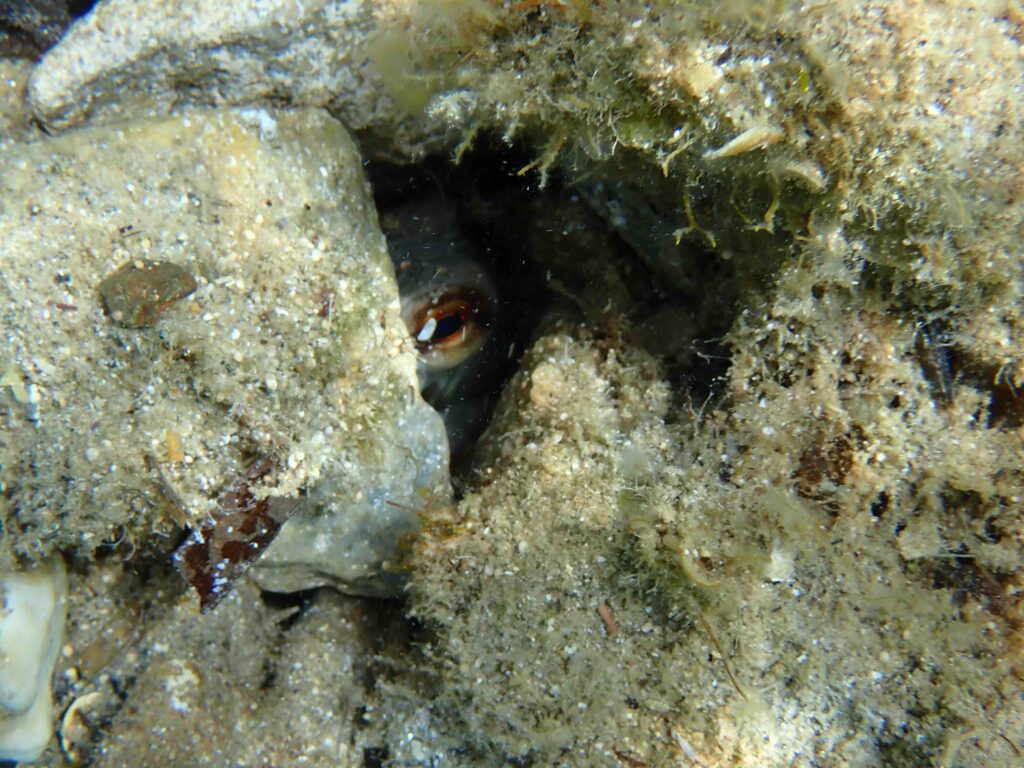
Their hiding place is sometimes ‘decorated’ by small stones and shells, pieces of algae or grass; authors reported that octopus can distinguish brightness, shapes, size and orientation of object.
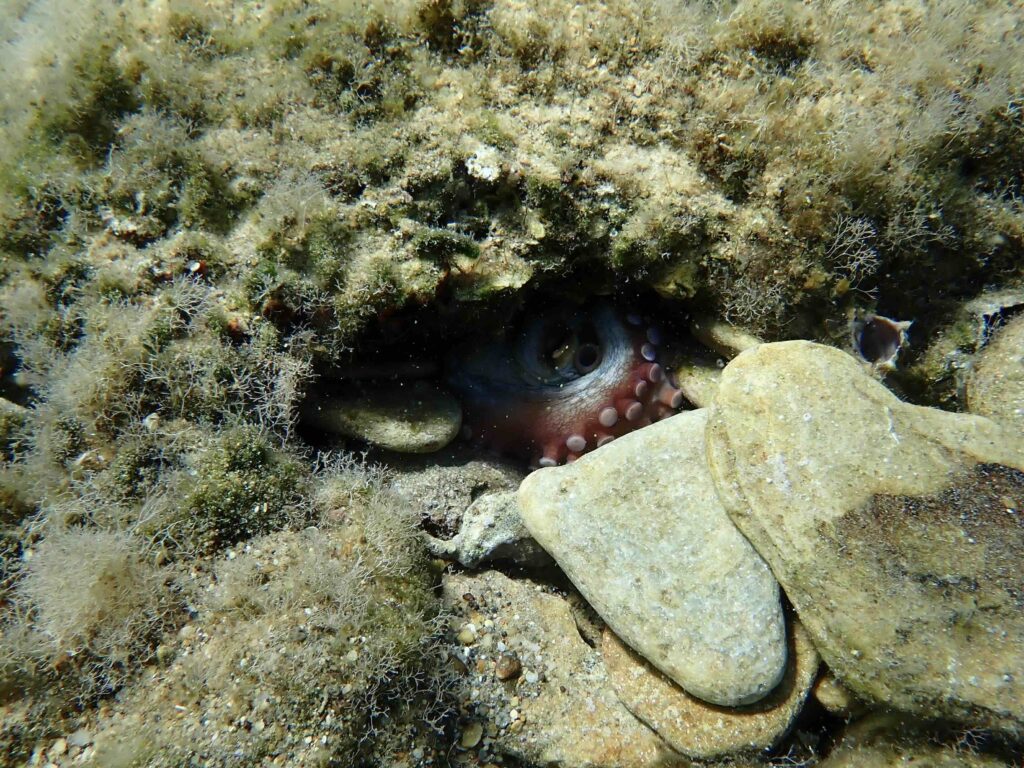

The nervous system is well-developed, with a brain protected in a cartilaginous capsule and the animal is rather intelligent! For instance, octopus can recognize people and behavioral experiments have shown that they can unscrew a jar containing a prey!
Reproduction. Life span: ca. 2 years. Sex is separated. Male and female are mature when reaching a weight of ca. 200 g and 500 g, respectively. Male has a modified arm (sexual dimorphism). This arm, named hectocotylus, lacks suckers, its extremity is spoon-shaped, and a groove occurs all along its length. Mating occurs after a courtship. The male introduces the hectocotylus into the female’s mantle cavity and spermatophores are canalized along this tentacle into the oviduct. Spermatophores contain sperm that will fertilize the eggs in the oviduct. The female lays eggs (70 000 – 600 000), and this during up to 30 days, depending on her size. Eggs (ca. 2.5 mm in diameter) are gathered clusters attached to the roof of the female hiding place. The female will take care of the eggs (oxygenation and protection against predators), usually then stopping feeding (incubation varies: 20 – 30 days at 25°C, and up to 120 days at 13°C). After hatching, juveniles swim owing to mantle contractions (backwards propulsion) and become planktonic. They will stay in the plankton for 1 or 2 months. The female usually dies shortly after this brooding period.
Geographic distribution. Worldwide. Western and Eastern Atlantic, southern coast of England to southern coasts of South Africa; Azores, Canary and Cape Verde Islands, Mediterranean Sea, Black Sea. Pacific and Indian Oceans coasts.