Encounters on the sand…
Rocky bottoms, soft sediments and seagrasses beds occur in shallow water along the Antiparos coast.
Providing a stable and hard substrate, massive rocks often allow a large variety of benthic organisms to settle, forming diversified benthic communities where food and hiding places are particularly various. In contrast, soft sediments look at first sight ‘desertic’, however by observing them more closely, life is well present and diversified.
 Soft sediments (gravel, sands, mud) are loose substrates made of particles of various sizes and nature (mineral or organic). Mineral particles mainly originate from soil and rock erosion (they reach seas and oceans being transported by rivers, winds or melting glaciers). Biogenic particles fall down the water column accumulating on the seafloor, they result from living forms activities (e.g., faeces, gametes, decay of dead animals and plants, skeleton/shells, …).

In shallow waters soft sediments are subject to continuous reworking owing to waves, tides and currents mainly, but also to animal activities such as foraging and displacement. Consequently, the settlement of benthic organisms is at first sight ‘problematic’ on this unstable substrate! They have to grow fast, or to bury, or to develop root-like stems as do seagrasses (the only large plants living on soft sediments).

Animals colonizing soft sediment are buried (infauna) or live at its surface (epifauna). A major part of them feeds on detrital particles by being deposit- or suspension feeders, but scavengers also occur that feed on decaying organisms (animals or plants). In turn, infauna and epifauna are the preys for fish, crustaceans or mollusks passing by.

Let's have a look to animals living on sandy bottoms ...
BUSY FISH …
When snorkelling over sandy bottoms, you will surely meet some fish that behave a particular way! Hereafter are fish that did most intrigued me.
Fish digging headfirst in the sand
The striped seabream, Lithognathus mormyrus (Linnaeus, 1758) – Sparidae

The striped sea bream is a carnivore that digs sediments with its strong snout to capture worms, crustaceans, mollusks, sea urchins (infauna). It leaves typical cup – like depressions all over its prospected area.
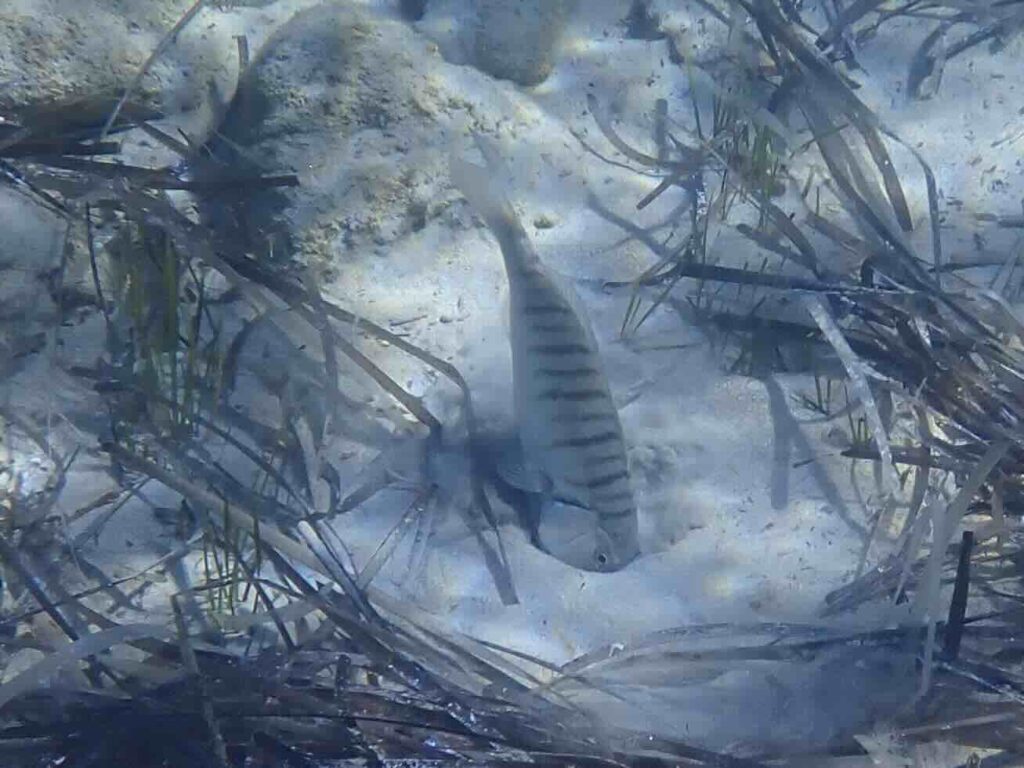
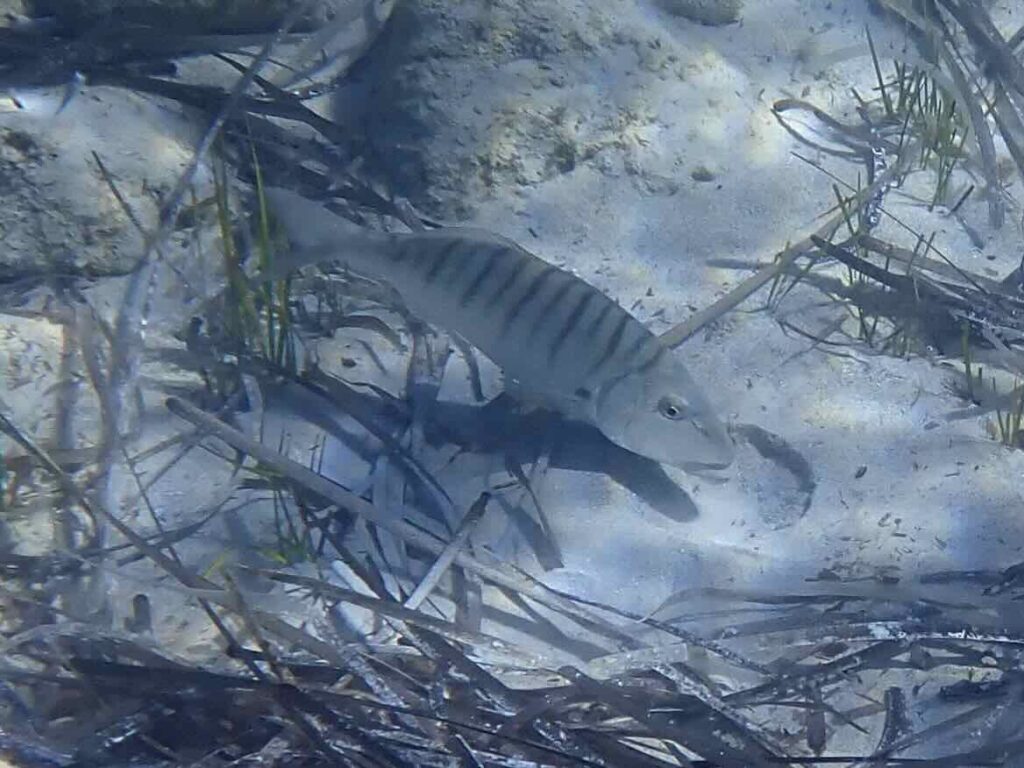

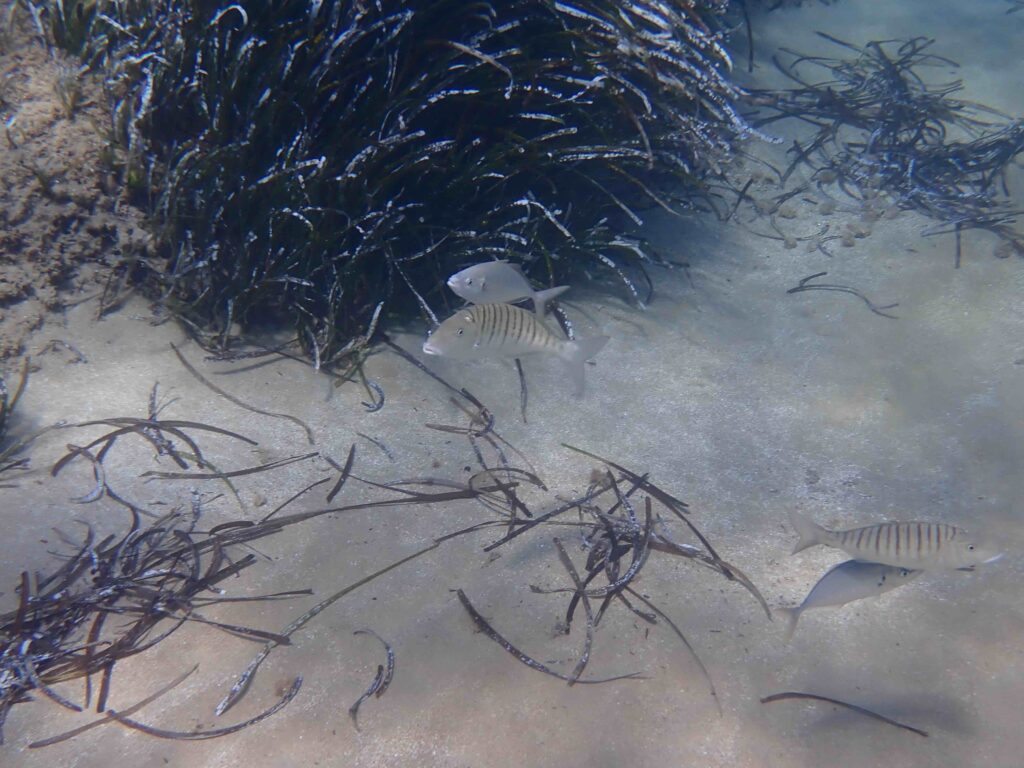
Description. Body colour: silver-Grey (or yellowish), back and flanks bearing up to 15 aligned black or brown vertical stripes, belly silver-grey. Size of observed individuals from 10 to 25 cm (it may however reach up to 50 cm). Elongated profile, with a pedunculate forked caudal fin; one dorsal fin (it extends up to the caudal peduncle). The head is strong with a typical curved dorsal profile. The snout is long and large, slightly flattened ventrally, the mouth is protractile with strong jaws and teeth. Large eyes, rather dorsal and far from the mouth.
Other species of fishes may swim close to the stripe seabream trying to benefit from dislodged preys.
Geographic distribution. Mediterranean Sea, East Atlantic coast (Channel, North Sea, Biscay Gulf up to South Africa), Indo-Pacific Ocean, Red Sea.
Fish in ambush
The weevers: the greater weever and the starry weever
Weevers live on soft bottom; they are partly or almost completely buried (their eyes then only emerging from the sediment). They display a particular technique of hunting by ambush, feeding on small fish (gobies, sand eels, anchovies) and crustaceans (shrimps, mysids) passing by. They use their powerful tail to pounce on a swimming prey.
Important to notice: weevers can be particularly dangerous for swimmers when walking in shallow waters. Indeed, weevers synthetise a highly toxic venom. The venom glands are associated to spines of the dorsal fin and of the opercula. Very painful injuries are induced when someone incidentally walks on the fish or manipulates it. The venom affects the nervous and circulatory systems. As the toxic substance in the venom is thermolabile between 40° and 50°C, a prolonged bath of the wounded limb in hot (40-42°C) water or the application of hot compresses can be a first-aid attempt. It is however necessary to see a doctor for an adequate treatment.
More info’s in: https://en.wikipedia.org/wiki/Greater_weever, and, https://doris.ffessm.fr/Especes/Trachinus-draco-Grande-vive-637
Four species of weevers occur in the Mediterranean Sea. They can easily be distinguished by the size and position of their eyes, and by the shape of their pupil (among other features). See for instance the comparative pictures in: https://doris.ffessm.fr/Especes/Trachinus-radiatus-Vive-leopard-2625
I met two species in shallow water (between 0.5 and 3 m depth), the greater weever and the starry weever (also named streaked weever).
The greater weever, Trachinus draco Linnaeus, 1758 – Trachinidae
Body laterally compressed and elongated (length: 20-30 cm), with the flanks having brown and blue oblique stripes (the brown stripes may be ‘fragmented’ into aligned brown patches). The mouth is oblique, opening upwards, giving a fierce/angry look. Eyes are large, closed to each other’s; they have a round pupil and are bordered by a gold-coloured line that displays a typical upper notch.
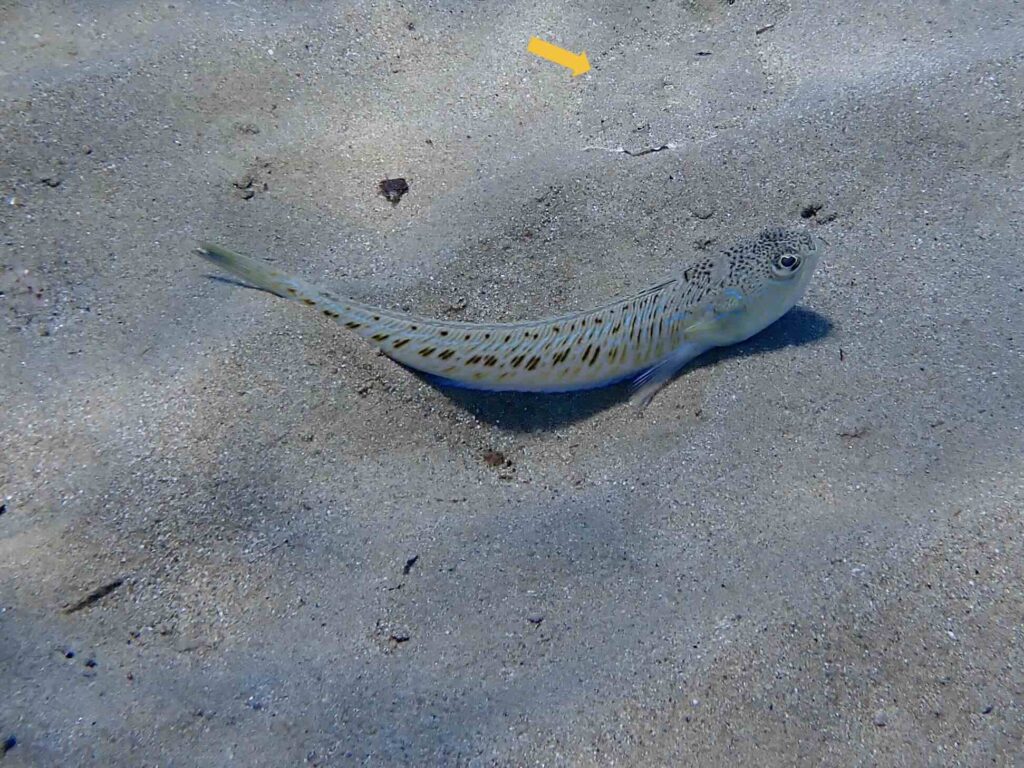
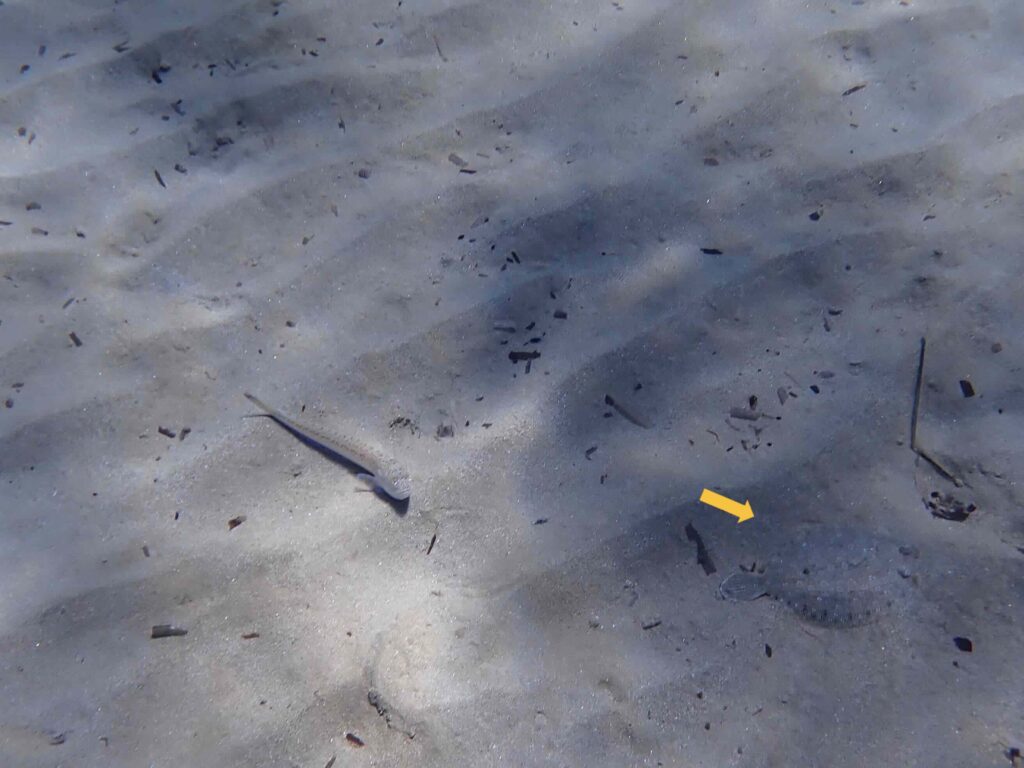
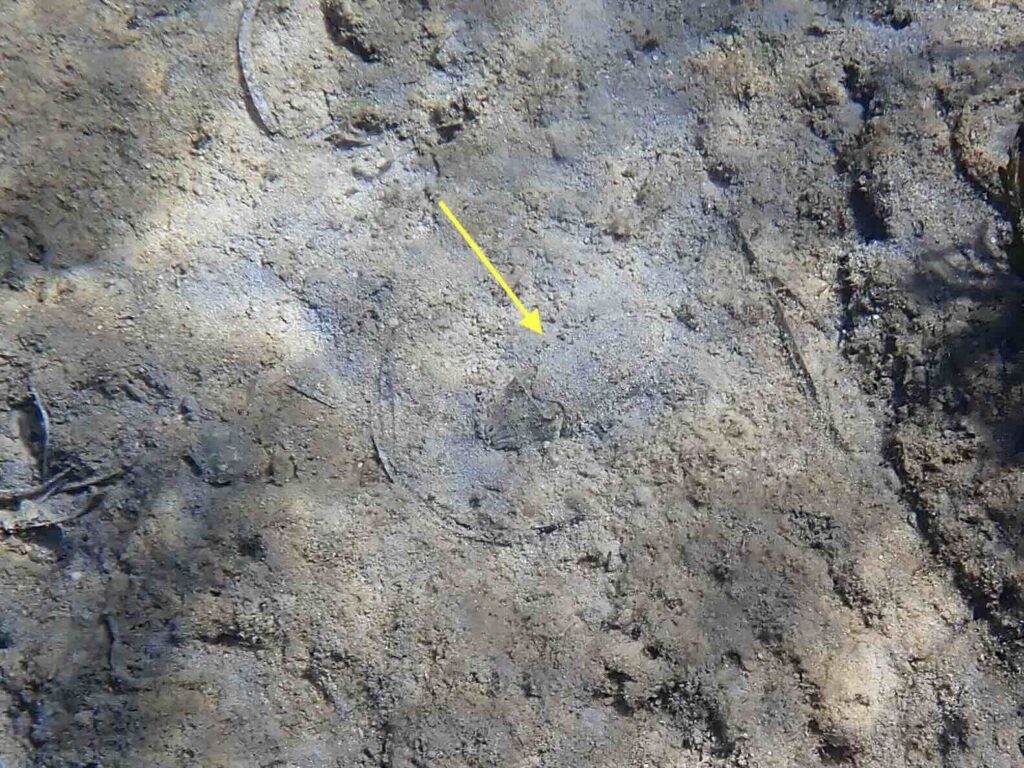
The yellow arrow indicates a wide-eyed flounder (Bothus podas) closely staying next to the weever, presumably waiting for remains of its meal …
Venom apparatus. There are two dorsal fins, the first one is short (triangular), dark-coloured, with 5-7 spines each connected to a venom gland. The second dorsal fin only bears soft rays. Each opercula also bears a venom spine.
Reproduction from June to August (with regional variations). Eggs and larvae are pelagic (planktonic), the eggs hatch after 3 months. There is no parental care and seemingly no territoriality.
Geographic distribution. Mediterranean Sea, Black Sea, North Sea and Northeast Atlantic from southern Norway to Morocco.
The starry (or streaked) weever, Trachinus radiatus, Cuvier, 1829 – Trachinidae
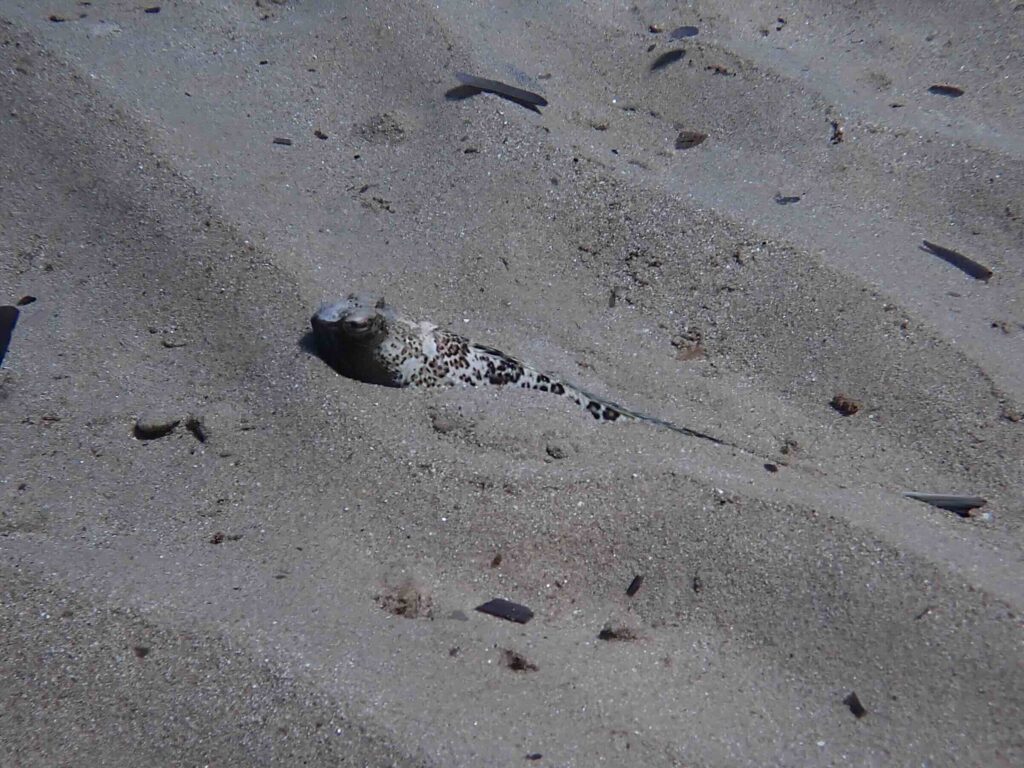
Like the greater weever, the starry weever has an elongated body, a mouth oriented upwards, the same attitude and feeding method. It differs from the greater weever, by its eyes, its flanks color and its more massive outline. The eyes are close to each other’s, quite dorsally located; the pupils are narrow and elongated. Behind the eyes, radiating bony ridges (visible in the above picture) give this weever its name.
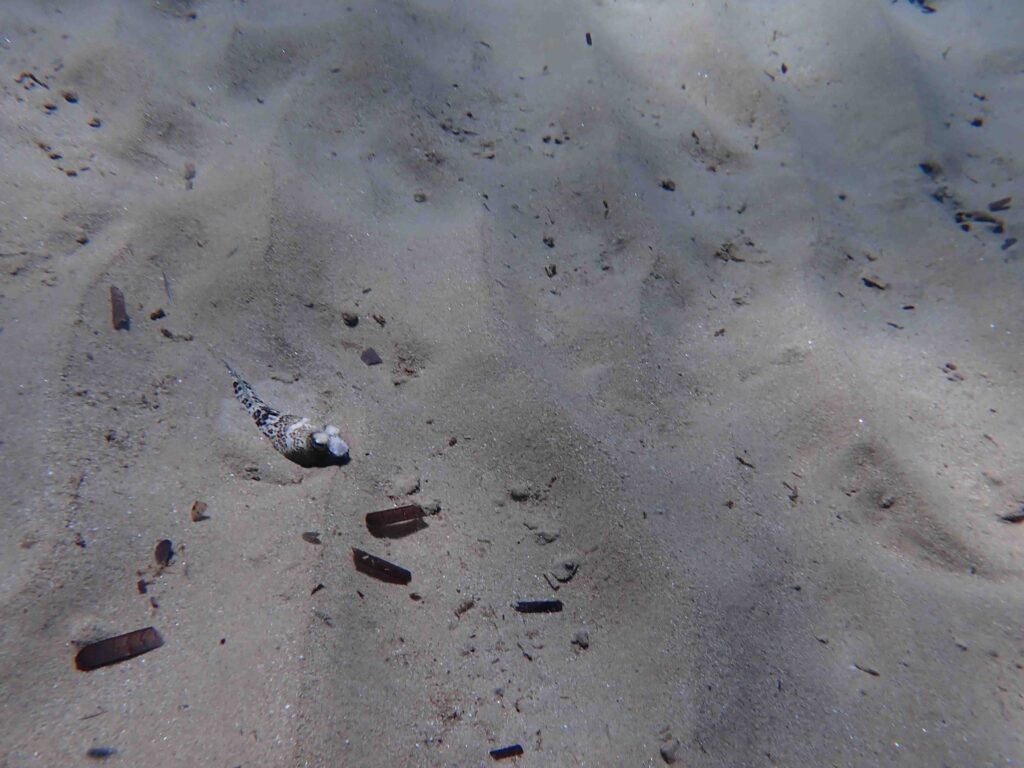
The head of the starry weever exhibits rapid colour changes: it can darken dramatically against a violet to reddish background. The body background colour is whitish to brownish, but flanks and head are mottled with brown or black, with large brownish patches, some forming ring surrounding a clearer center. The belly is uniformly whitish.
The size is 15-20 cm for the fish I met; it can however reach up to 50 cm.
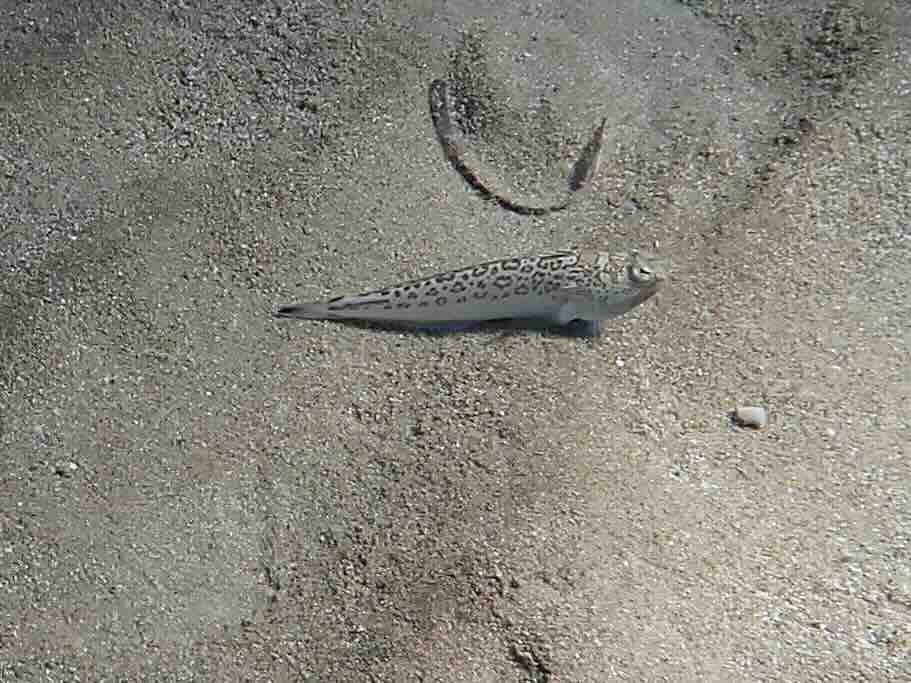
Venom apparatus. There is a large venom spine on each operculum, and 2 or 3 smaller ones on the dorsal edge of the eye orbit. There are 6 venom spines on the first dorsal fin (a small dark fin, pointed by the yellow arrow on the picture below) and no venom spines on the second dorsal fin. The anal fin bears two venom spines.
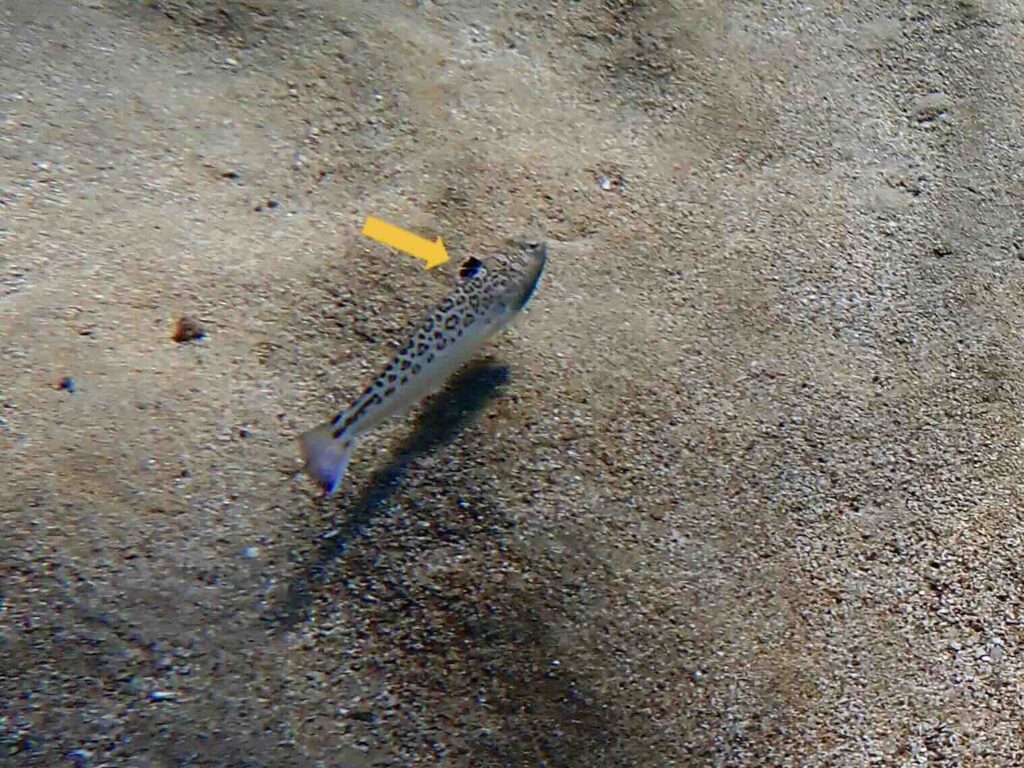
Reproduction. Occurs in spring or summer (with regional variations). Eggs and larvae are planktonic. The starry weever migrates to shallow waters to spawn, a behaviour that increases the risk of envenomation for swimmers.
Geographic distribution. Mediterranean Sea, East Atlantic Ocean from Portugal to South Africa.
The Atlantic lizard fish, Synodus saurus (Linnaeus, 1758) – Synodontidae
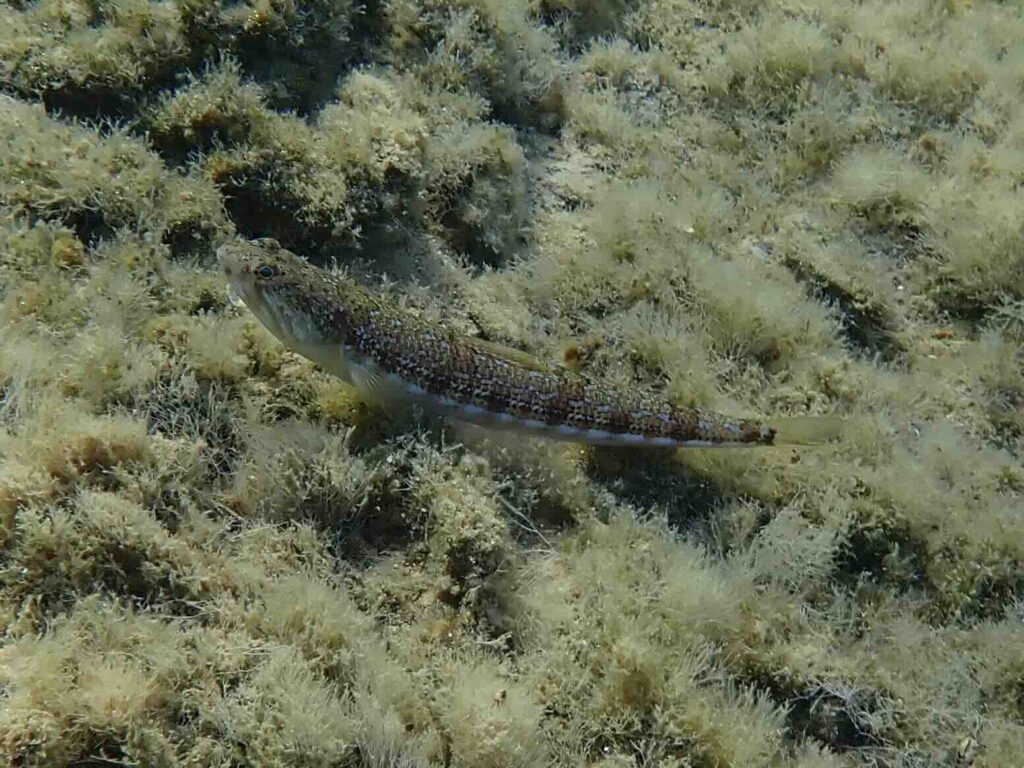
The Atlantic lizardfish lives on sandy bottom, on sandy patches between rocks or sea-grasses beds, or on hard substrates (coated with sediment and sessile organisms) at depths up to 20 m (known up to 400 meters).
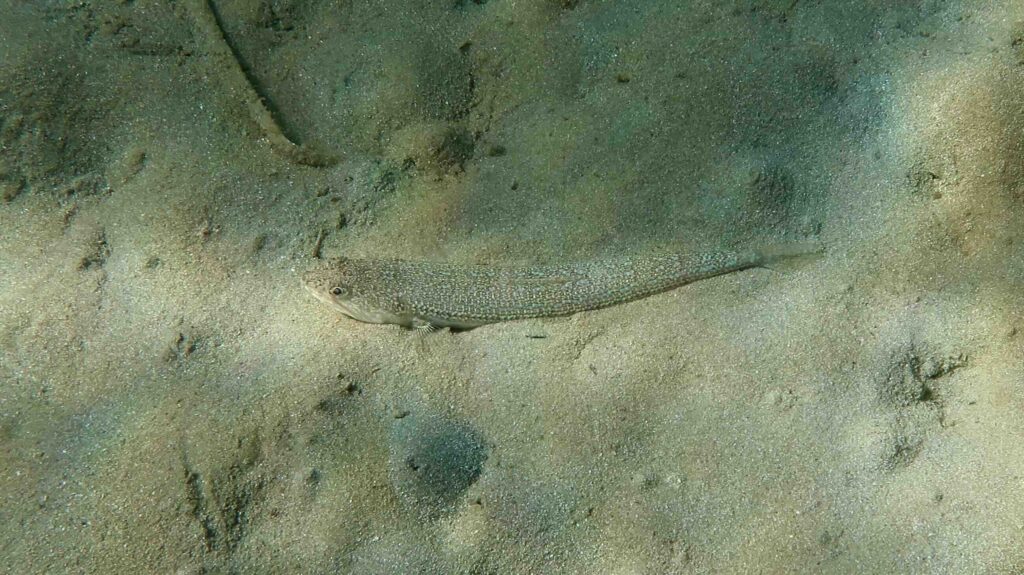
Partly burrowed in the sediment or totally exposed when on hard substrates, it resembles the weever by its ambush behaviour: it can pounce on prey passing by, even if a few meters above it. This predator catches fishes (e.g., sardines, gobies, wrasses or juveniles’ fishes) and invertebrates (crustaceans, small cephalopods).
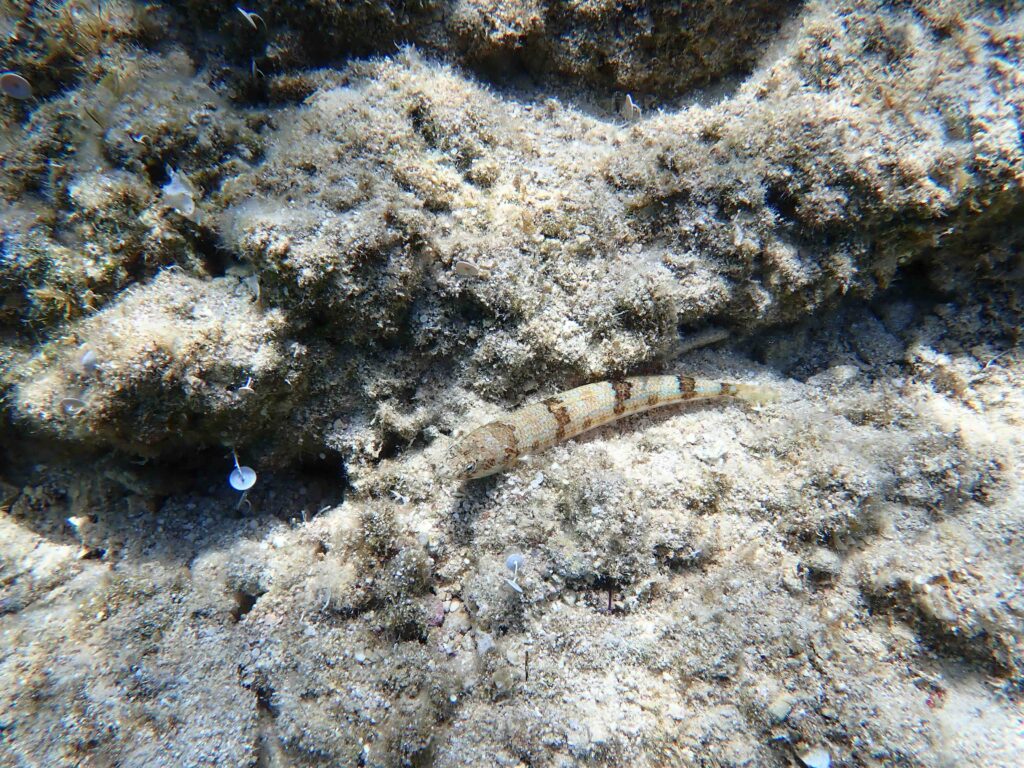
Description. Body elongated (up to 40 cm in length), with a small triangular dorsal fin (and a small soft fin behind). The eyes are dorsal, green in color and bordered by an orange ring. Body colour may vary according to the background substrate: it is usually clear, brownish, or greyish, darker dorsally, with 8 to 10 regular vertical bands extending laterally, with blue or white horizontal lines along the flanks.
Reproduction. Sexes are separated (gonochoric species). External fecundation, mating in spring and summer.
Geographic distribution. Eastern Atlantic (Morocco, Mauritania, Cape Verde and Azores), Mediterranean Sea, Western Atlantic (Bermuda, Bahamas, West Indies).
A fish that profits from others
The wide-eyed flounder, Bothus podas (Delaroche, 1809) – Bothidae
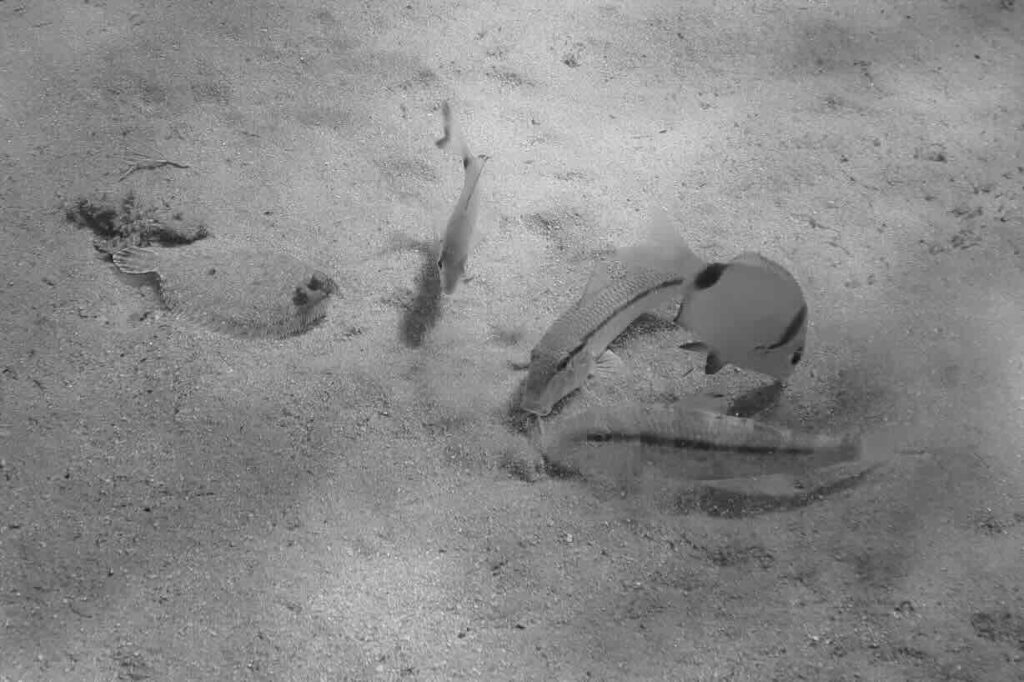
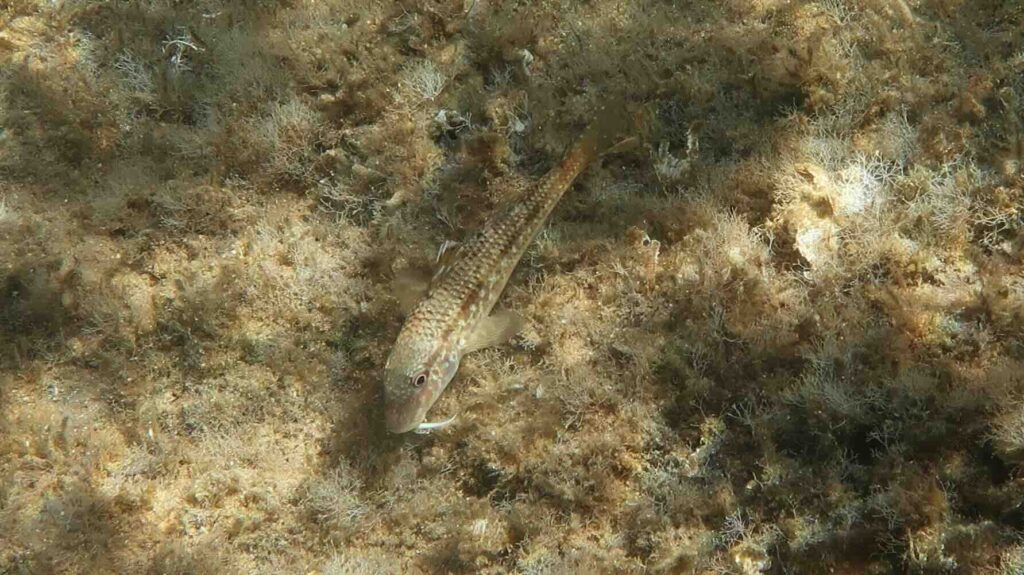
The wide-eyed flounder is a flat fish that uses to follow other fish, trying to benefit from their foraging activities. Its food consists of benthic small fish, worms, crustaceans, mollusks and sea urchins, i.e., preys notably dislodged by fishes like the striped red mullet (see pictures below), the weever fishes and the striped seabream.
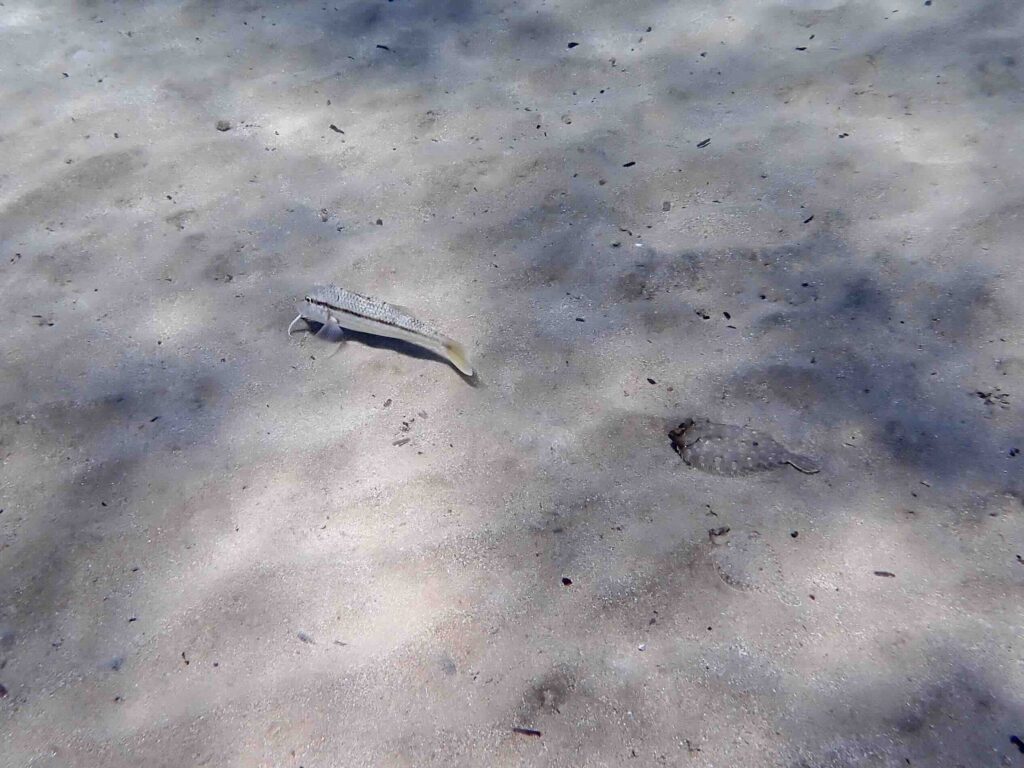
A few words about flatfish… Flatfish are for sure bizarre animals! They are laterally compressed and asymmetrical, with one side (left or right) facing the seafloor and the other one, the water column. Both eyes are thus on the upper flank. This asymmetric morphology is acquired during the metamorphosis of the juvenile when one eye migrates next to the other one across the top of the head. Eyes are either on the right or on the left body side; accordingly, the flatfish are said right-eyed (dextral) or left-eyed (sinistral). This is often a species feature, but not always.
Flatfish swim owing to the undulations of their dorsal and anal fins that line the body margins (pectoral fins are less conspicuous).
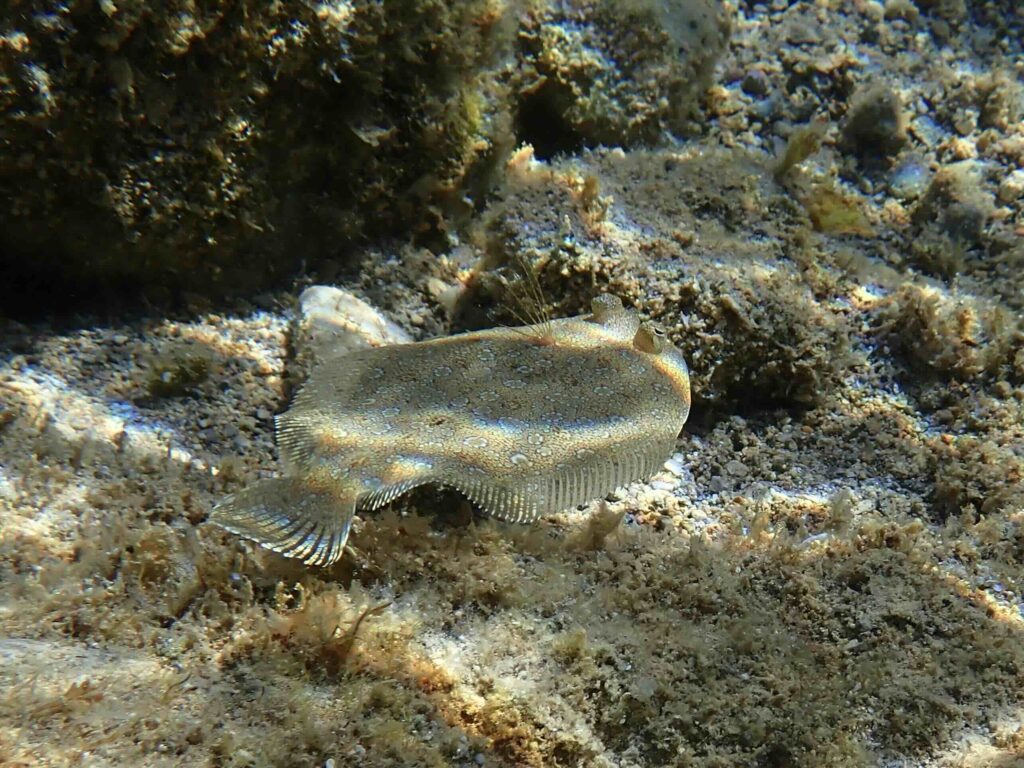
The wide-eyed flounder is a sinistral flatfish (both eyes on the left side; the right side facing thus the sea bottom). The eyes are rounded, large and prominent with one eye more frontal, next to the mouth.
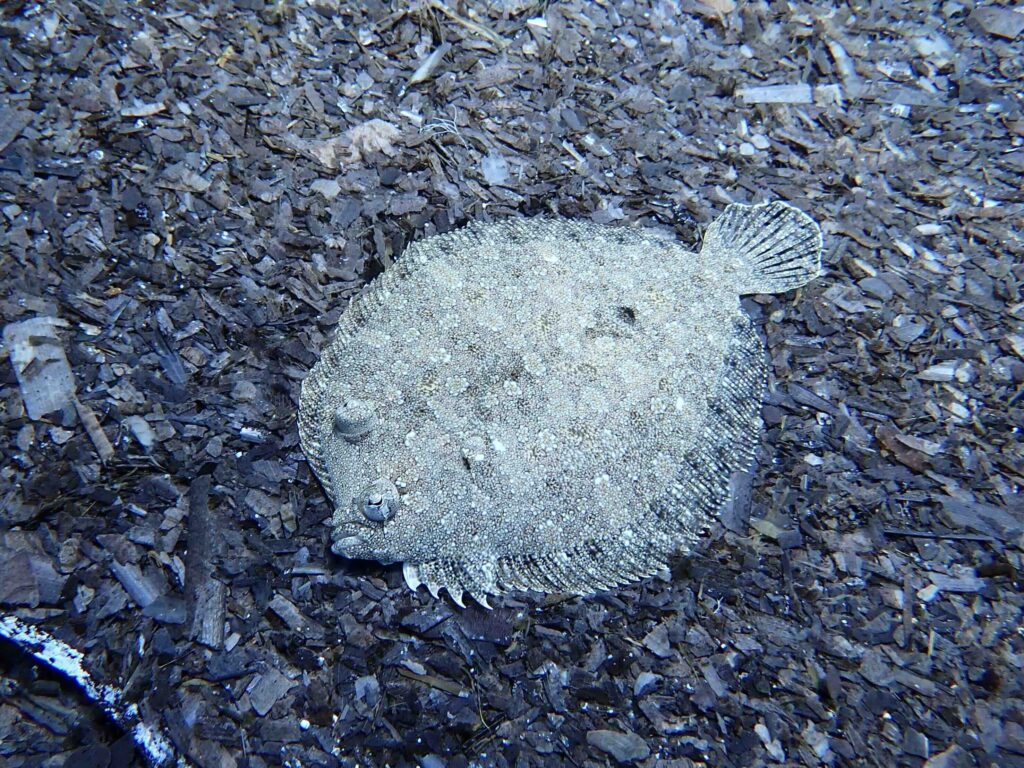
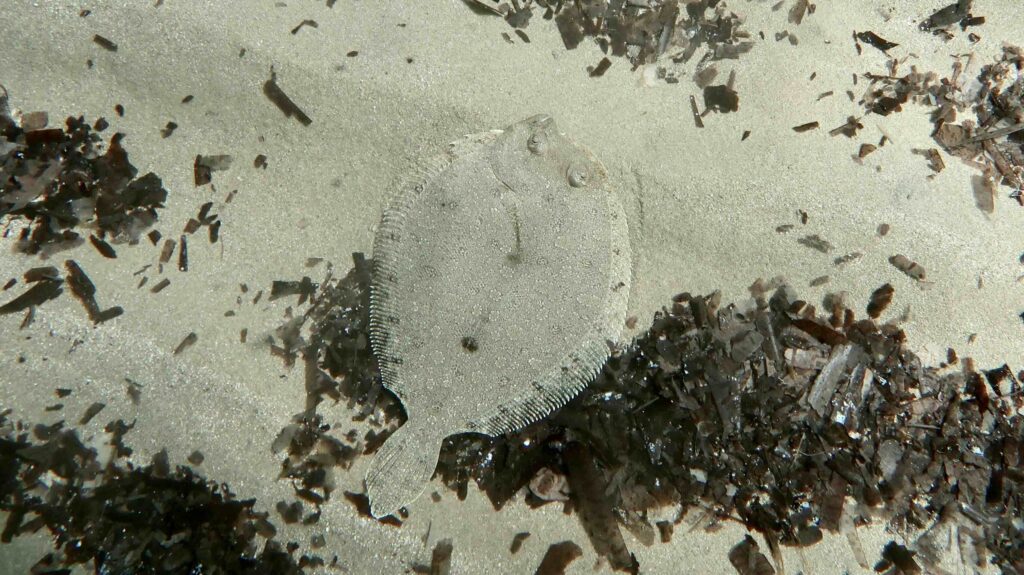
Male and female differ by their size (males reaching 45 cm and females 20 cm in length), by the larger inter-orbital space in male (higher than the eye diameter) and by the body profile, very straight in males, more rounded one in females (see the two pictures below)
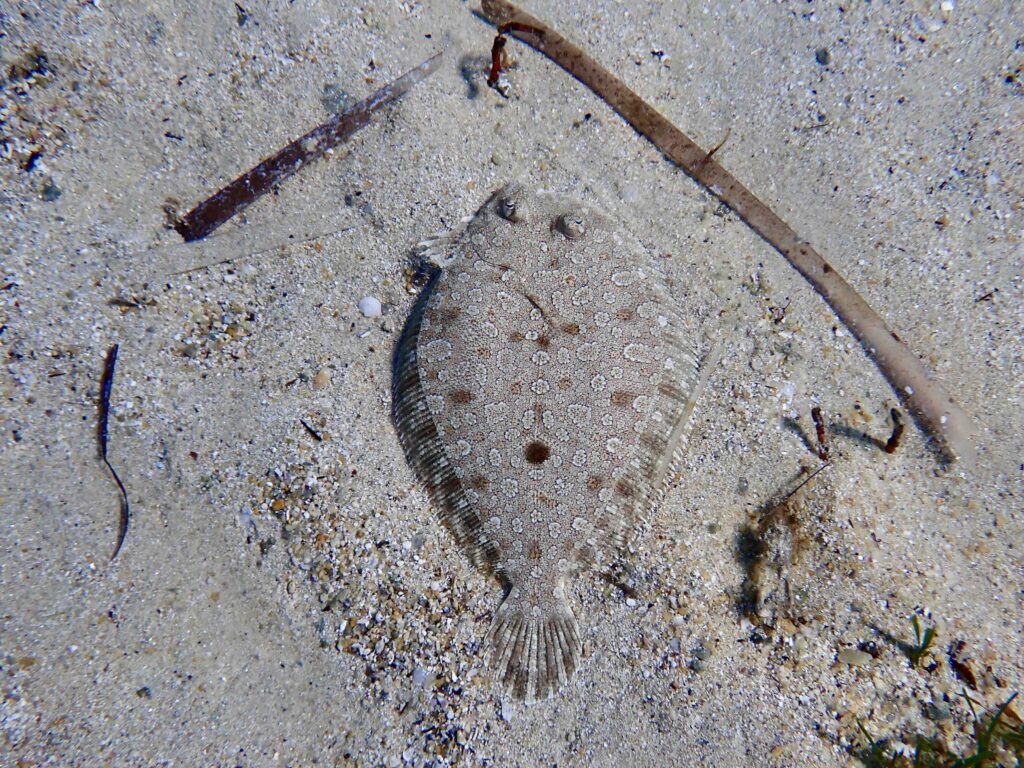
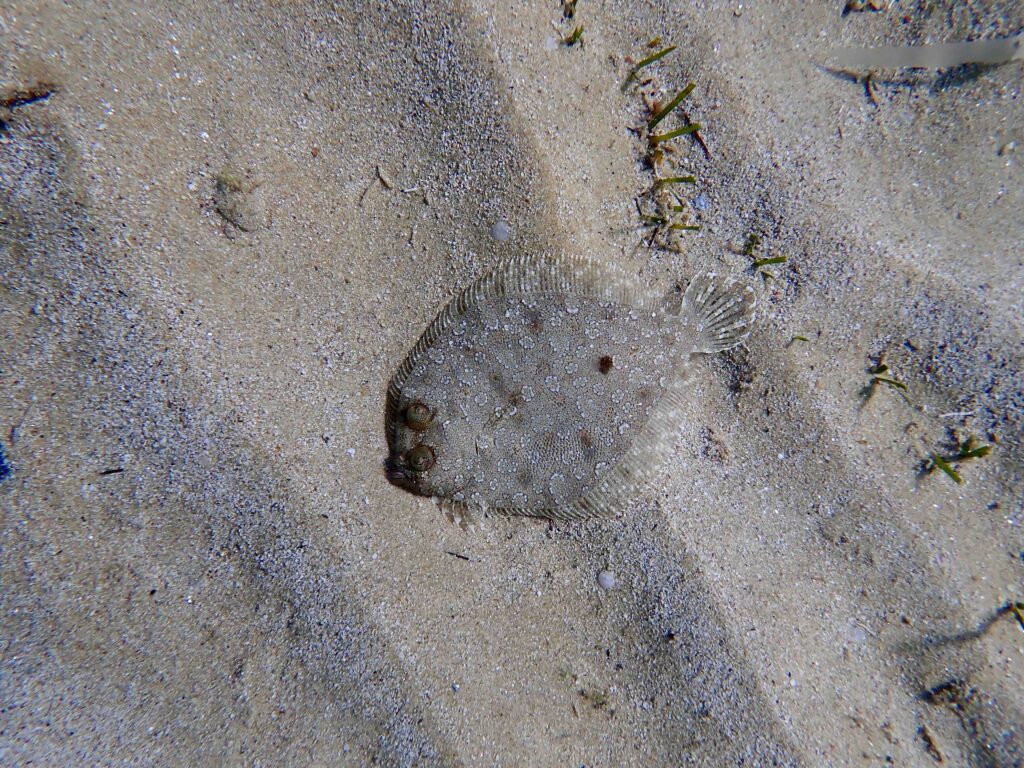
Camouflage. The body side facing the seafloor is whitish or brownish while the side facing the water column mimics the background colour (‘camouflage’). Changes of colour are due to pigmented cells, the chromatophores, which size and distribution vary according to stimuli exerted by the immediate surrounding. Colour changes are not only a way to avoid predation, but also to communicate on the mood state: e.g., angry/aggressive fishes can become dark-coloured while fishes showing submission are greyish.
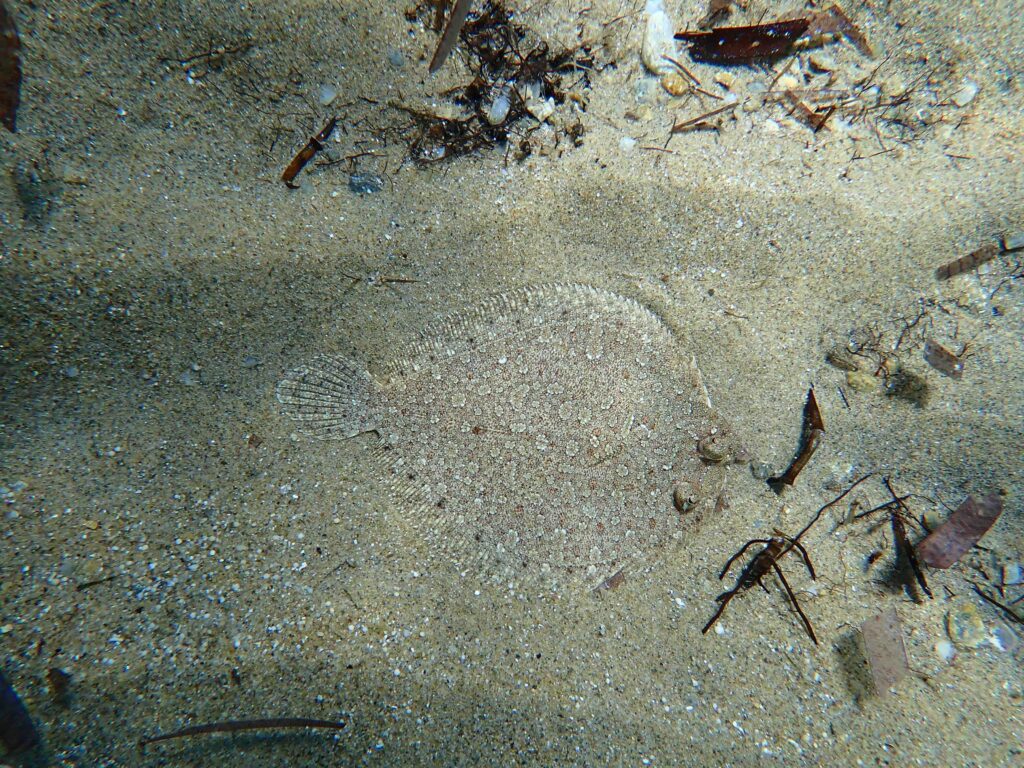
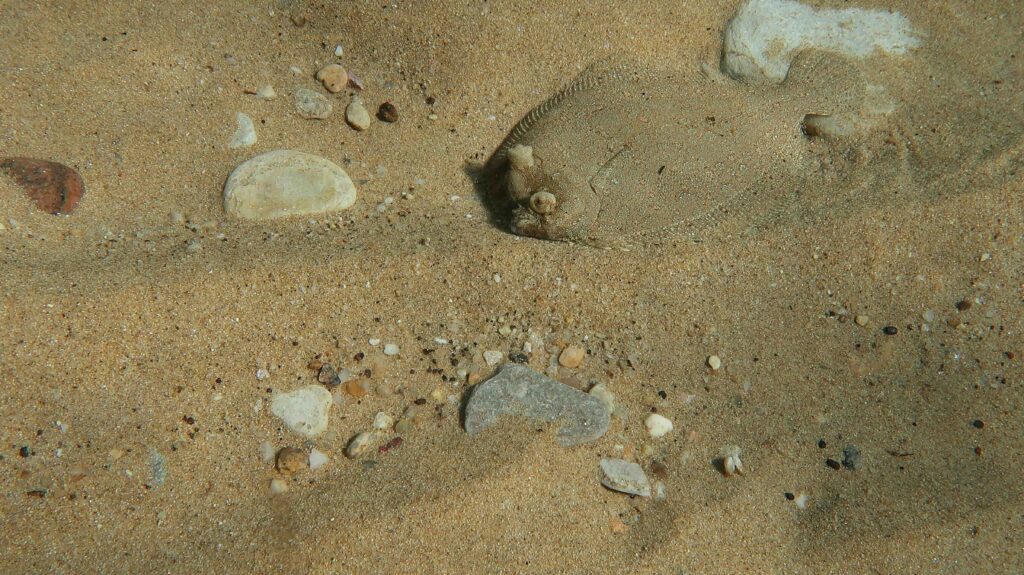
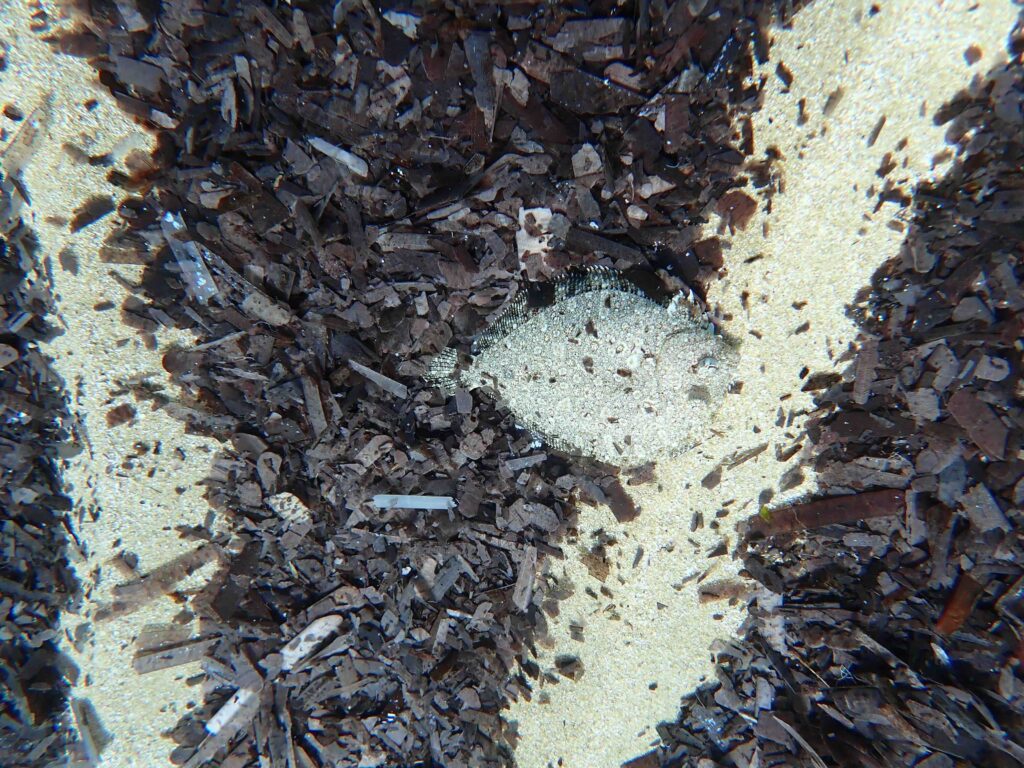
A challenging situation in the above picture!
Reproduction. Sexes are separated. Reproduction occurs from May to August, during early morning hours. Males are territorial, they display a courtship and may mate with several females. Sperm and eggs are released on the sediment where fecundation occurs. Larvae and juveniles are pelagic. Larvae are symmetrical i.e., resembling ‘typical fish’. The asymmetric morphology is acquired during the metamorphosis of the juvenile, when one of the eyes migrates next to the other one.
Geographic distribution. Mediterranean Sea, South-East Atlantic, from Angola up to Portugal, Madeira, Azores, Canary Islands.
A fish actively stirring up sediment
The striped red mulet, Mullus surmuletus Linnaeus 1758 – Mullidae

Description. Elongated body, slightly compressed laterally, bearing conspicuous scales. Large head with a small subterminal mouth and with two mobile chin barbels foldable into two ventral grooves. Two dorsal fins, the first one with black/brown and white stripes. Caudal fin forked, usually yellow. The lateral line is well-marked and often dark coloured (brown or red). Colours vary according to the background substrate (sand, gravels or rocks) and to the moment of the day (diurnal vs nocturnal variations). During the day, usual colour is pinkish beige with a dark (often red) lateral line and a clearer ventral side; during the night or when on rocky substrates, the body is mottled with gray or red.
In shallow coastal waters, the body size is 10 – 20 cm, larger individuals (up to 40 cm) occur in deeper waters (80-100 m).
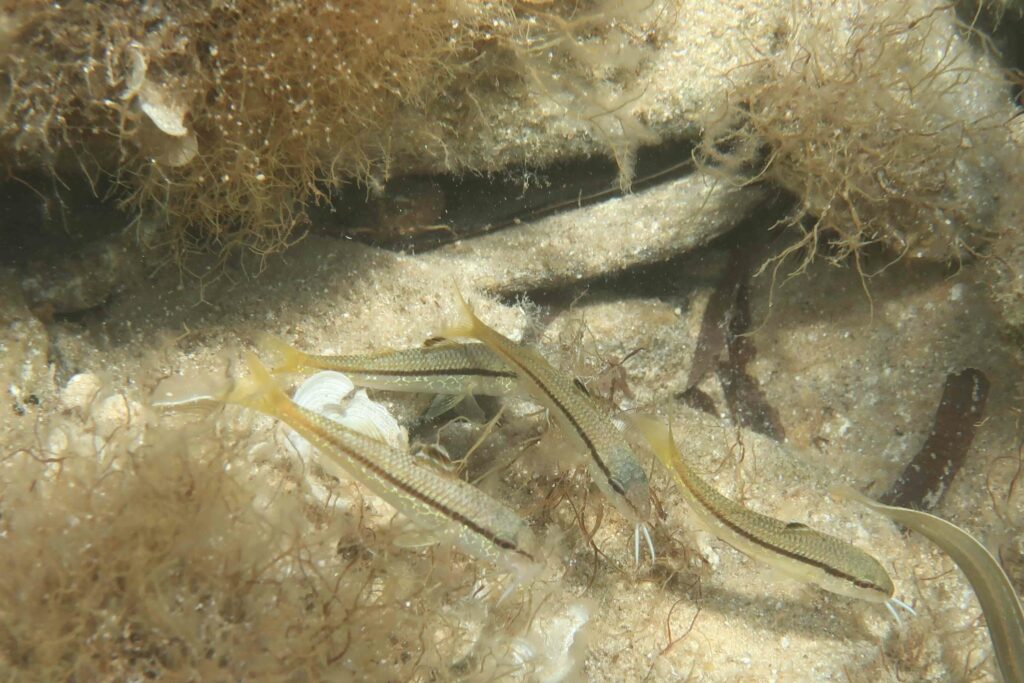
Habit… and association. The fish is frequently seen on soft sediment (sand, gravels, mud), or on sediments patches between rocks or in sea-grasses beds. It probes the surface of the substrate, actively stirring up sand or mud with its two chin barbels to dislodge preys (worms, small mollusks, and crustaceans). The chin barbels also serve as sensory organs detecting preys.
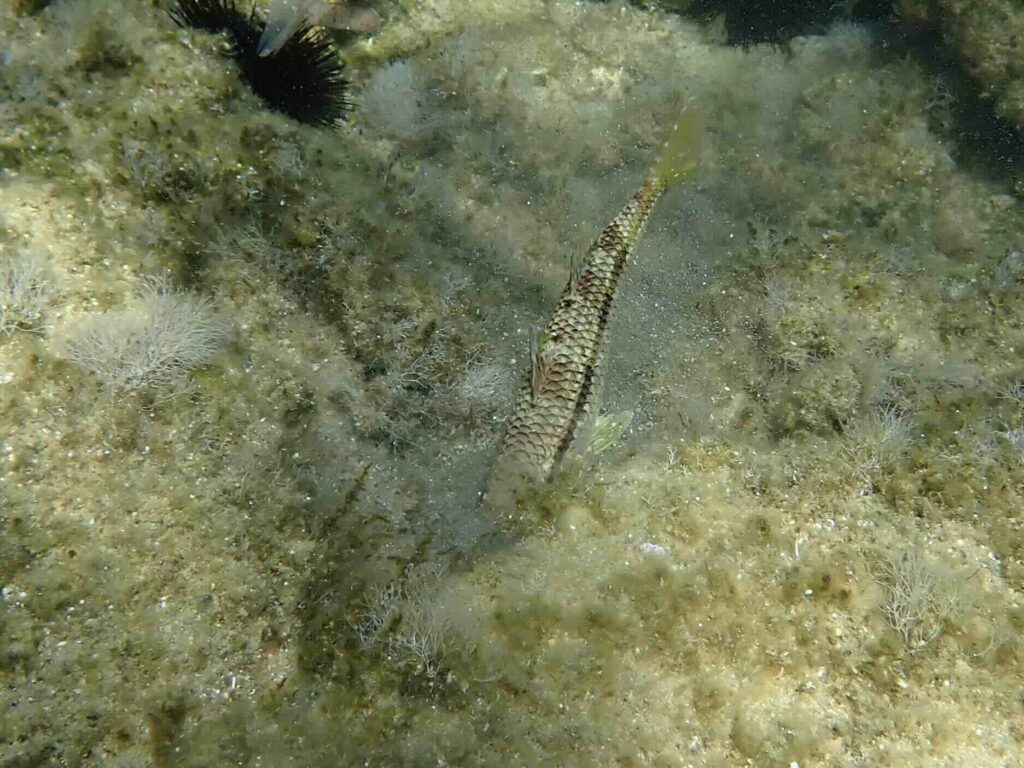
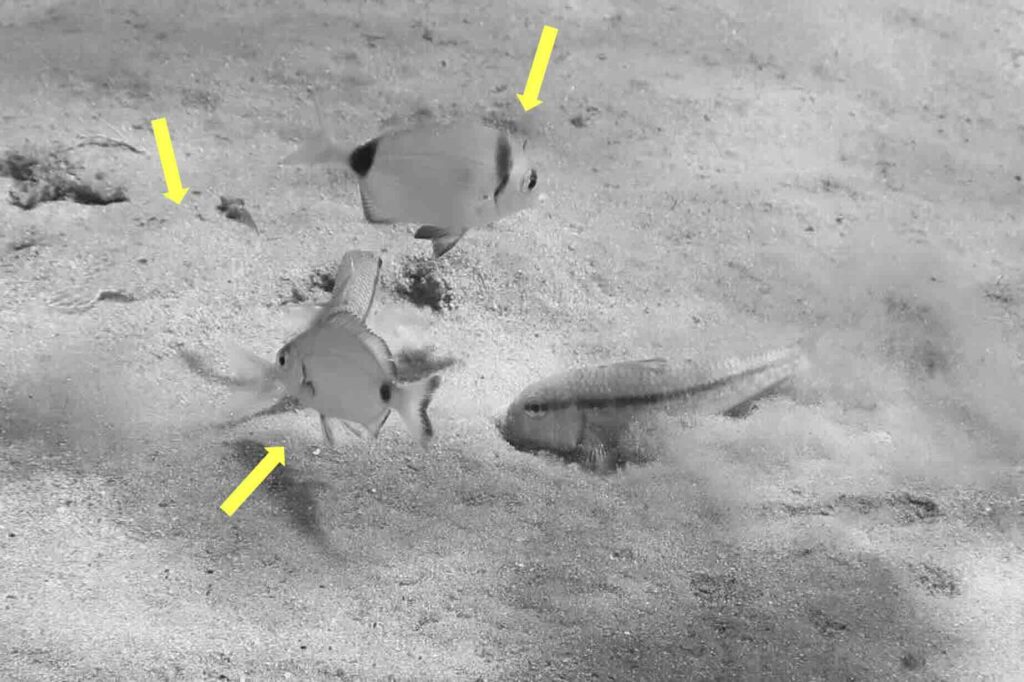
The striped red mullet is rarely alone! Other fish take advantages of its stirring up activities. They are in its wake or even alongside it, scavenging the preys unearthed from the sand or discarded.
In the black and white picture below, yellow arrows point a wide-eyed flounder (left), a black-headed seabream (right), a common seabream (below).
Pictures below: small school of young individuals swimming in harmony in very shallow water (50 cm depth), observed early morning in June (and occurring in the same area for several days).


Reproduction. April-June. Eggs and larvae are pelagic. They reach coastal areas in September-October as juveniles.
Geographic distribution. East Atlantic coast (from Scandinavia to South Maroco), Canaries, Mediterranean Sea, Black Sea.
Astonishing encounters
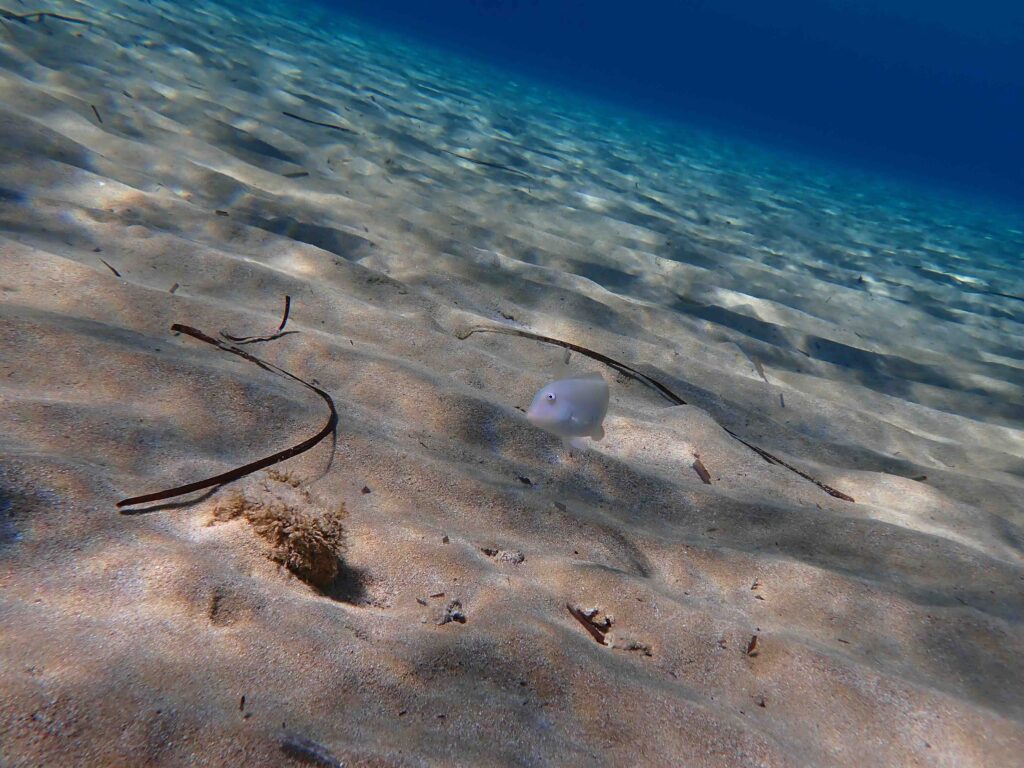
The Pearly razorfish (or cleaver wrasse) – Xyrichtys novacula (Linnaeus 1758) – Labridae
What an unexpected animal ! ... It is shaped like a razor, has a tropical look, and behaves strangely by remaining stubbornly close to the same spot on the seafloor.
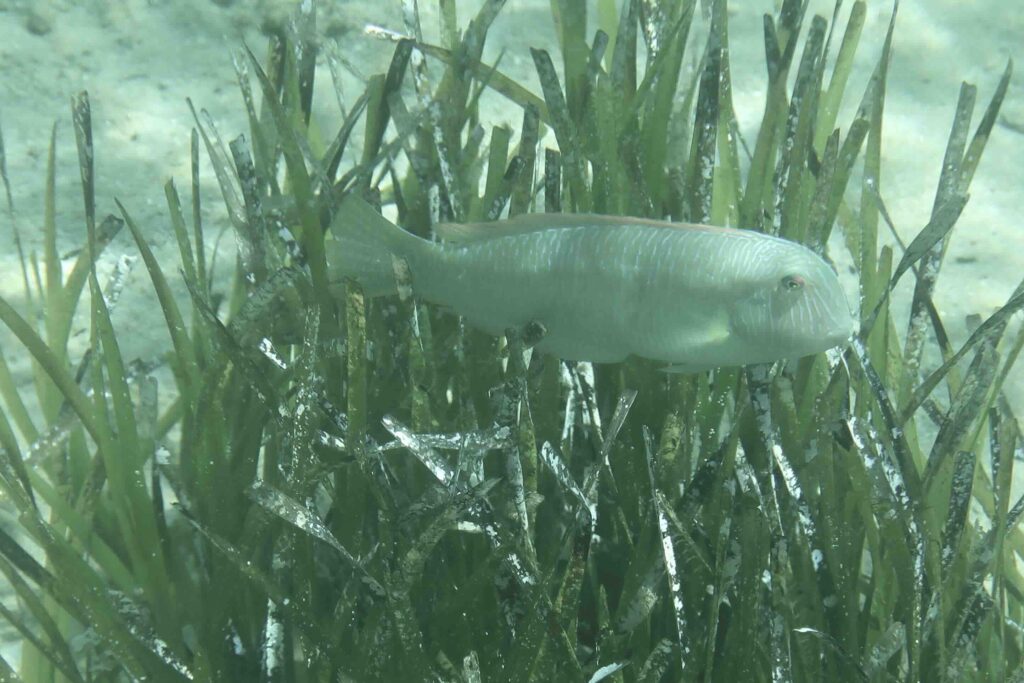
The razorfish has a very narrow and abrupt forehead, hence its vernacular and its scientific names.  Xyrichtys novacula … from the Greek ‘xyráfi (ξυράφι)’ and from the Latin ‘novacula’, both words meaning ‘razor’.

Description. Length up to 40 cm but 25 – 15 cm for those I observed. Whole body elongated and very compressed laterally, flattened head with a typical steep profile. Eyes near the top of the head. Mouth rather small and low, with pointed teeth. Long dorsal fin extending along most of the back. Caudal fin short, rounded posteriorly. Lateral line discontinuous, with two discontinuous sections.
Females are pinkish or yellow orange while males are greenish (above picture); both sexes may be marked with green and gray stripes. Anteriorly, the flanks of females, harbour a few aligned scales brighter compared to the other ones (picture of female below). Head with alternating light blue and yellow orange vertical lines. Small individuals (seemingly young females) are greyish with darker vertical bands along their flanks.
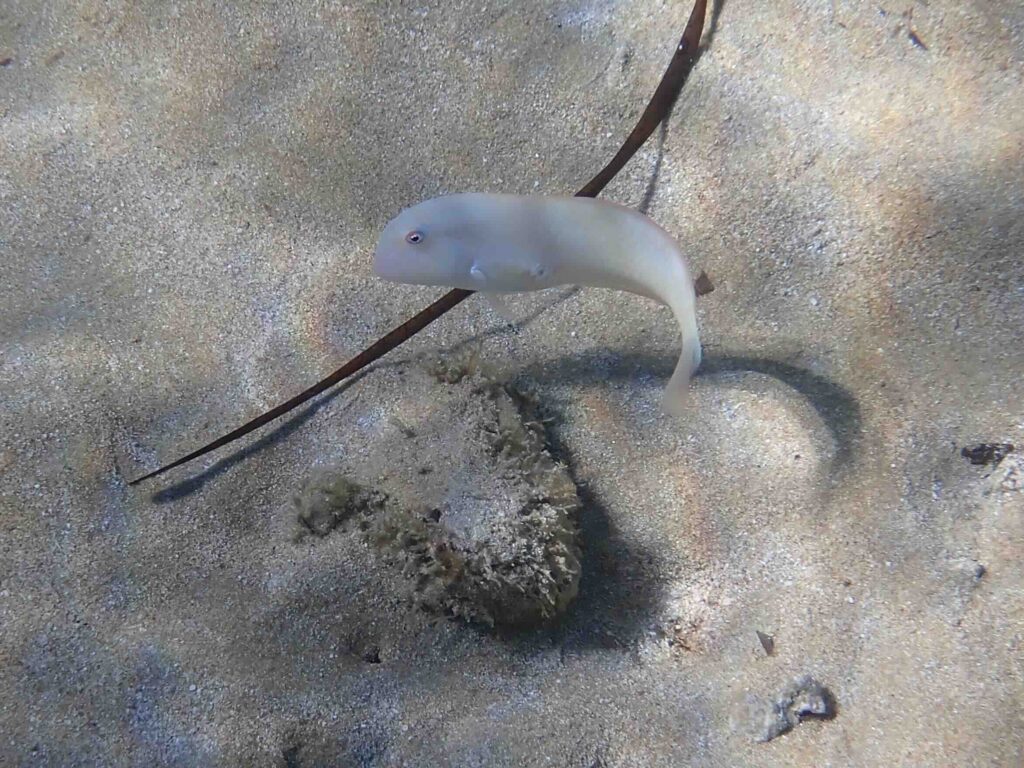
Habitat and behavior. Common fish inhabiting clear shallow sandy bottoms, usually in the vicinity of seagrass beds (depths: 3 to 90 m). It dives headfirst into the sand burying itself rapidly when frightened; it is also said to spend the night and part of the winter buried in the sand. Usually observed staying next to little piles of debris or small rocks (shelter/nest?). It uses to swim above these places, often in an oblique position.
Food. Small invertebrates living in the sediment, mainly mollusks (gastropods, bivalves), crustaceans (crabs, shrimps) and echinoderms.
Reproduction. Protogynous hermaphrodite. Female becomes mature when reaching a size of 10-15 cm, it harbours a red ventral spot (gonad place) which attracts the male for mating. Female usually becomes male when reaching a size of 17 cm. The male is solitary and territory. It surveys a harem of females and fiercely attacks any intruders. In its territory, a small depression in the sediment is the place where it buries at night. Mating occurs in the water column during summer. Eggs and development are planktonic.

Distribution. Mediterranean Sea; Eastern Atlantic (from Portugal to Congo; Azores, Madeira, Canary Islands); Western Atlantic (from North Carolina to Brazil, Caribbean). Originates from tropical Atlantic.
The Reticulated filefish (or leatherjacket), Stephanolepis diaspros (Fraser-Brunner, 1940) – Monacanthidae
At first, with its tropical look, this fish puzzled me a lot!
It is a Lessepsian migrant i.e., a species that reached the Mediterranean through the Suez Canal. It originates from the Western Indian Ocean and the Red Sea. It was first recorded in the Mediterranean in 1927 but is now common in the eastern Mediterranean basin.
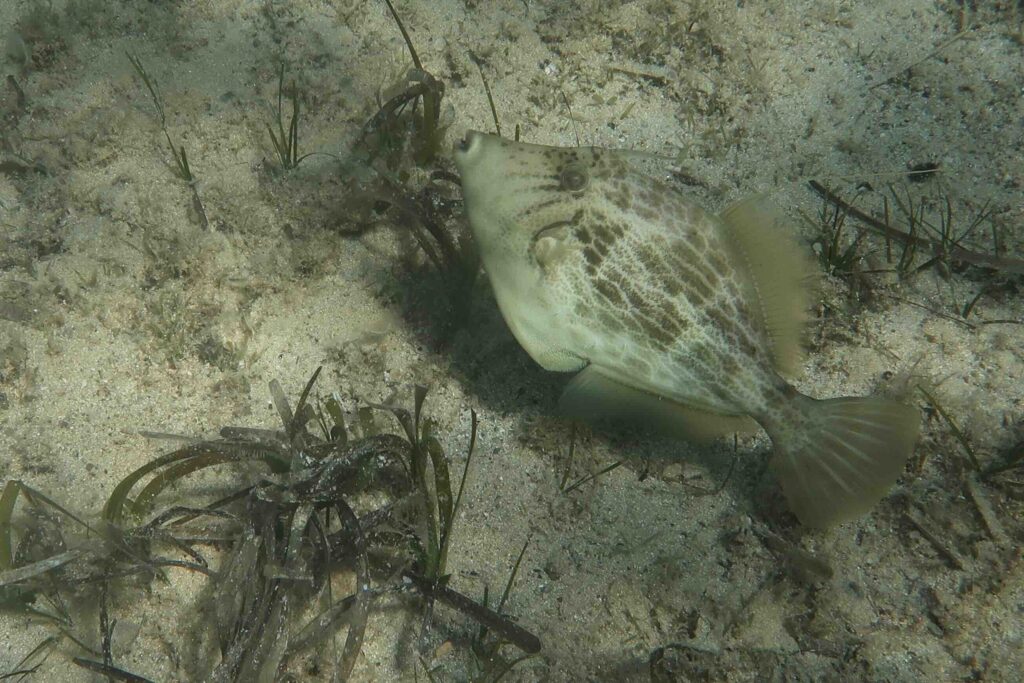
Description. Body laterally compressed, with a rounded ventral profile. The skin is typically rough with tiny scales each bearing a fine translucent spicule (conspicuous on picture below). The head is pointed with a small terminal mouth. Slit like gills openings anterior next to the basis of the pectoral fin. NB: this fish resembles a triggerfish, but its elongated head and its rough spiny skin are distinctive features.
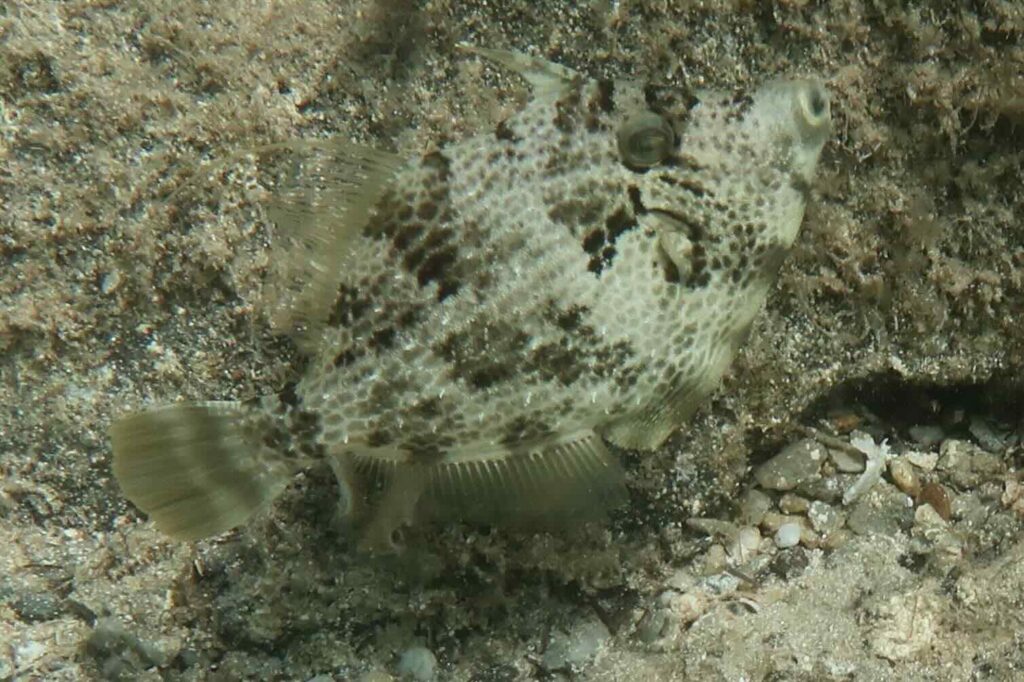
Two dorsal fins. The first one is aligned with the posterior edge of the orbit, shaped like a like a spine and folding backward. The second one borders most of the posterior half of the body length; its second ray bears a long flexible filament (well developed in males and visible on the picture below). Pectoral fins small, formed by a flap of skin. Caudal fin rounded, fan-shaped, prolonging a strong caudal peduncle. Maximum length of 25 cm.
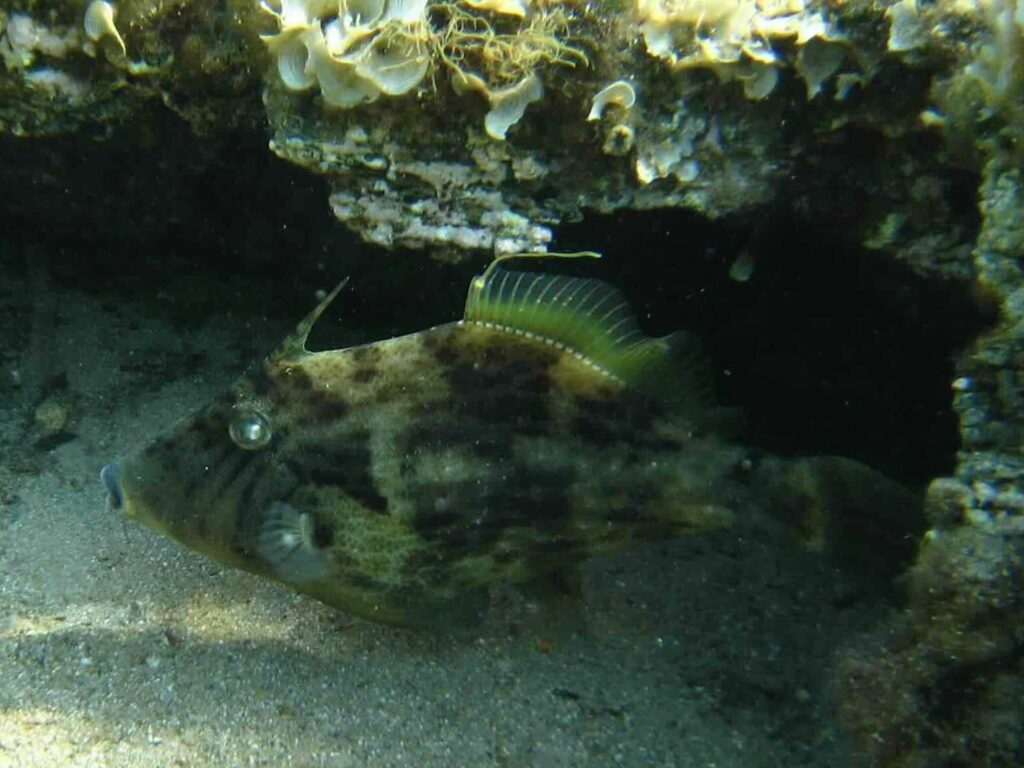
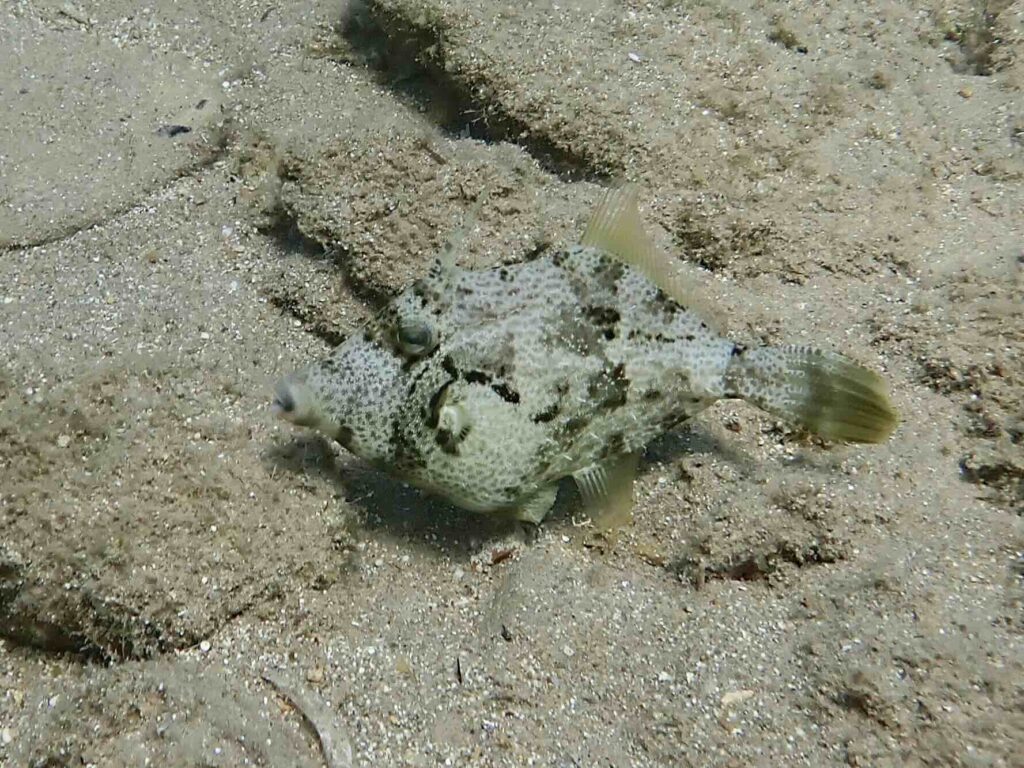
Colour rather variable. Brownish purplish to greenish grey or light brown, with pattern of brown/black spots, and brown or whitish broken lines on the flanks; dark oblique lines may be present on the head, some radiating from the eye’s margins. Dorsal and anal fins are yellowish or greenish in colour.
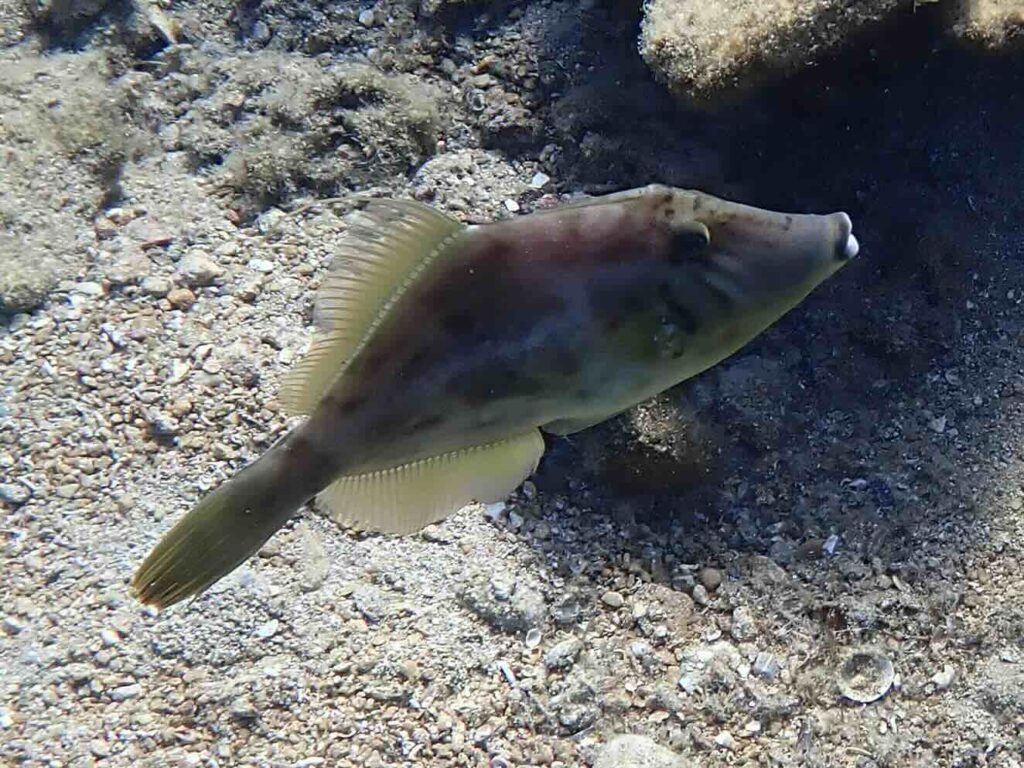
Habitat. Shallow coastal waters (depths 2-5 m), on sandy areas with scattered rocks or on rocky substrate, seagrass meadows .
Food. Various small invertebrates (sponges, cnidarians, crustaceans, mollusks, bryozoans, and echinoderms). Also, some plant and algal material.
Reproduction. Sexual maturity at lengths of 9.5 cm for males and 8.5 cm for females. Breeding season in spring-summer (up to December in Tunisia).
Shy cuttlefish …
The common or European common cuttlefish, Sepia officinalis, Linnaeus 1758 – Sepiidae
Cuttlefish (as Octopus) are mollusks that belongs to the Cephalopoda (from the Greek plural: κεφαλόποδες, kephalópodes meaning ‘head-feet’). This refers to a particular anatomical feature: the head bears the foot!
The foot of cephalopods is modified from the primitive molluscan foot; it forms a set of flexible arms surrounding the mouth. The basic morphological features of cephalopods are presented in the section: ‘Hiding in crevices, overhangs on rocky bottom or among seagrasses’ for the common Octopus. Extant species of cephalopods include nautilus, cuttlefish, squids and octopods.
The cuttlefish Sepia officinalis lives in shallow water down to ca. 200 m deep. Occasionally observed on rocks, it is most often observed on soft bottoms and in seagrass beds. Partial burial in the sediment is common (see picture below).
Description. Body dorsoventrally flattened. Two big eyes are particularly striking on the head, harbouring a characteristic “W”- shaped pupil. The mouth is surrounded by 8 short and massive arms and by 2 long and retractile tentacles. The arms bear longitudinal rows of suckers; they serve to hold and manipulate the prey. The tentacles are longer than the arms; they only bear suckers at their flattened distal extremity. Usually, the tentacles are retracted, only rapidly extending to capture a prey (raptorial feeding). Cuttlefish are carnivorous. The mouth bears two hard jaws forming a parrotlike beak. The beak is made of tanned protein and chitin; it is operated by powerful muscles and allows to cut pieces into the prey. Size of the most encountered individuals are 15-30 cm in length (arms not included); maximum length 49 cm.
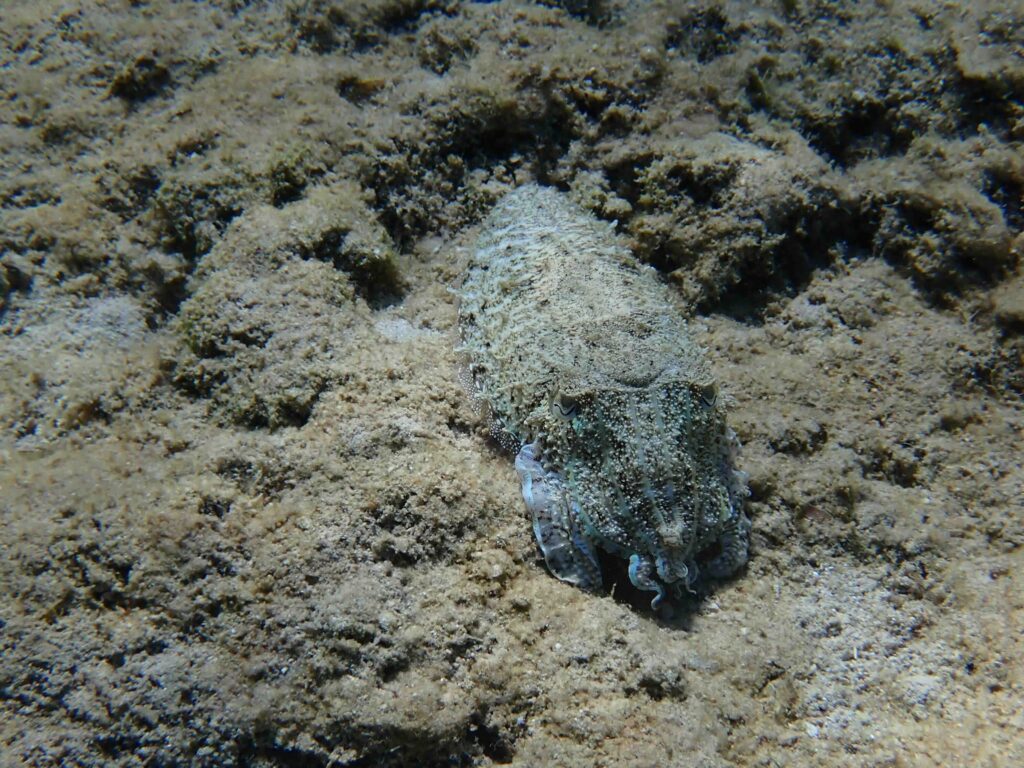
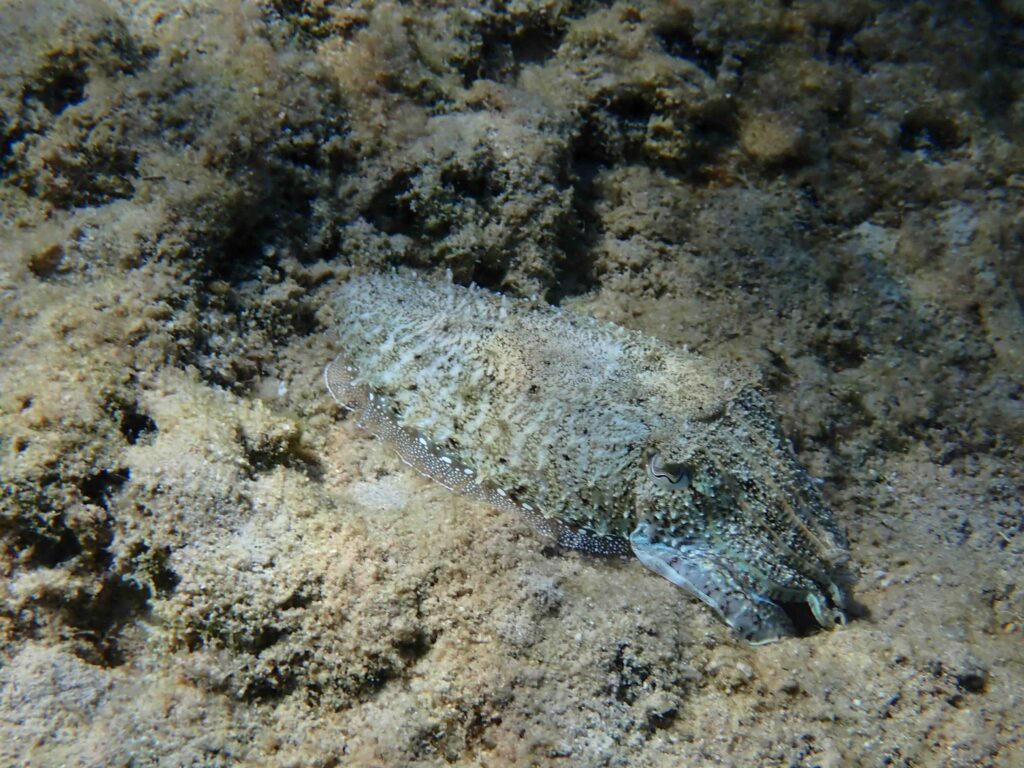
Colour and camouflage. Cuttlefish body is most often mottled with white and brown on the back, and pale on the ventral side. Males are distinguished from females by the stripes on the most lateral tentacles and the anterior part of the mantle. Cuttlefish display awesome camouflaging abilities through swiftly changes of their skin appearance. Coloured cells (chromatophores) can rapidly expand or contract modifying the skin colour while peripheral muscles can act on skin texture by distorting its surface into various shapes of protuberances. These changes either allow cuttlefish to blend into the surroundings, or to become very conspicuous. Emotions or excitement are for instance accompanied by waves of colored signals on the head and back. These changes can frighten and confuse prey or predators, or allow communication with other cuttlefish (e.g., during the breeding season).
Locomotion. Cuttlefish move forward by undulating their two lateral fins. Like the octopus, they can move rapidly ‘backwards’ by ejecting water from the mantle cavity through the siphon (jetting) due to the contraction of the mantle musculature, and when threatened, they can expel a cloud of black ink (*) that deceives their aggressor. Cuttlefish have an internal chambered shell (cuttlebone) involved in buoyancy in the water column. A complex mechanism allows the animal to vary the amounts of water and gas within it, thus precisely adjusting its mobility. This shell is dorsal and located in the mantle wall. It is often found washed up by the sea on the beaches.
(*) Cuttlefish ink or “sepia” was once used in painting (drawings, washes, watercolors) and to dye photography.
Food and feeding behaviour. Cuttlefish are efficient predators hunting by ambush, almost invisible for their prey (camouflage). The prey is seized by the long extensible tentacles, bring to the mouth, maintain by the arms and cut by the beak; a poison secreted by two posterior salivary glands reaches the prey tissues through the wound. Preys are fish, mollusks (gastropods, cephalopods), crustaceans (shrimps, crabs). In turn, cuttlefish are preys for many predators (seals, fish, dolphins, large fish, cephalopods, even other cuttlefish).
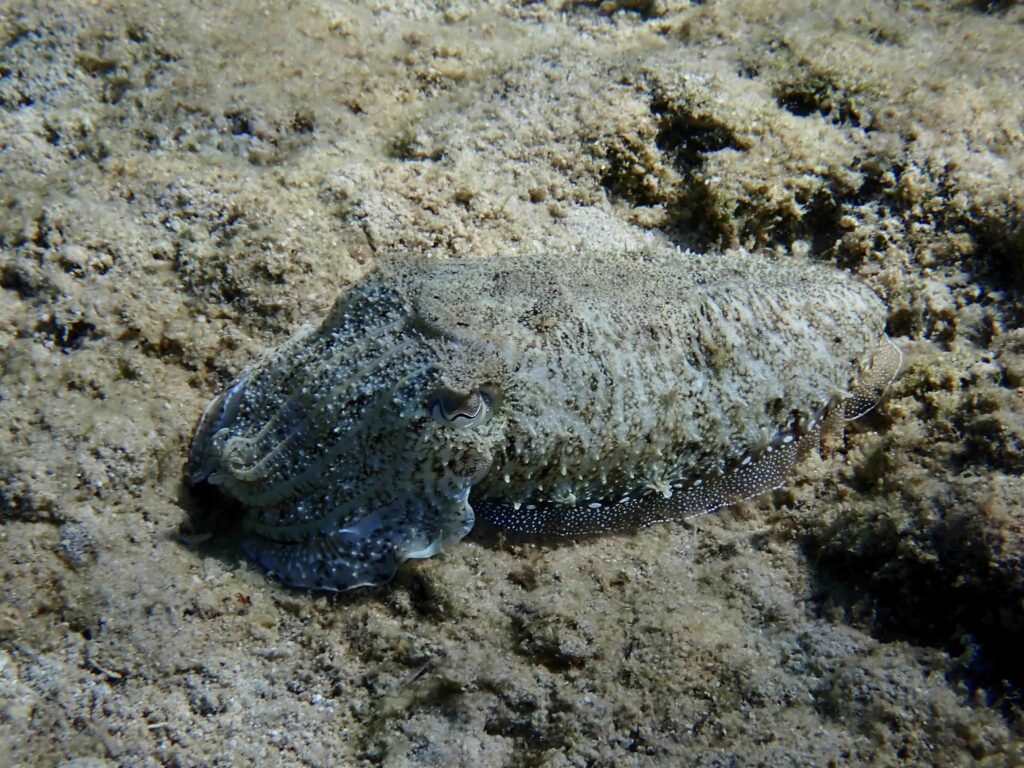
Reproduction. Cuttlefish spend the summer and spring inshore for spawning but move to depths of 100 – 200 m during autumn and winter. They reach their sexual maturity between 14 -18 months old and are gonochoric (sex separated). Mating occurs after courtships. The male introduces a spermatophore within the mantle cavity of the female, using its modified arm, the hectocotylus. Sperm liberated in the mantle cavity will fertilize eggs (internal fecundation). Gestation lasts for 30-90 days. Eggs are coated by a gelatinous secretion while in the oviduct; they are led in cluster by the female and attached to stable substrates as seaweed, shells etc… Hatching youngs (ca.15 mm in length) already catch small preys. They rapidly grow (10mm/week). Adults may live up to 2 years but most die after spawning. Cuttlefish eggs are consumed by several invertebrates as gastropods, crustaceans (lobster, crabs, Squilla) sea urchins, starfish.
Geographic distribution. Atlantic Ocean (from Baltic Sea, Nord Sea up to South Africa), Mediterranean Sea.
More info’s in: https://en.wikipedia.org/wiki/Common_cuttlefish, https://doris.ffessm.fr/Especes/Sepia-officinalis-Seiche-230, https://en.wikipedia.org/wiki/Cuttlebone
Echinoderms that like sediment
Echinoderms are exclusively marine, ranging from the intertidal zone up to abyssal depths. They include five extant classes: sea stars/starfish (Asteroidea), sea urchins (Echinoidea), sea cucumbers (Holothuroidea), brittle stars (Ophiuroidea) and sea lilies, feather stars (Crinoidea). They belong to the deuterostomes, a super phylum (*) that includes the chordates, … and among them, the vertebrates!
Echinoderms are for sure, strange animals! They have no head, no tail, no paws!… But several types of external appendages: spines, tube-feet, pedicellariae interact with the surrounding, allowing movement, attachment, catch, defense.
Adult echinoderms have a radial symmetry (usually pentamerous) that is acquired from a bilateral larva after its metamorphosis. By being benthic, the adults also differ from their planktonic, free swimming and ciliated larvae.
‘Echinodermata’ comes from Greek: ἐχῖνος (ekhînos) ‘hedgehog’ and δέρµα (dérma) ‘skin’. This refers to the spines borne by the internal (dermal) skeleton that is made of calcite-based plates, the ossicles. Ossicles are of different shapes and distribution. In most sea urchins, they are fused together into a sphere or a flattened (cake-like) skeleton that is named test, and they bear mobile erected spines. In sea stars, ossicles are next to each other’s, allowing some mobility of the body wall. In sea cucumbers the ossicles are scattered, usually small and isolated from each other’s in the connective tissue; their body is cylindrical, typically soft and flexible (longitudinal and circular muscular layers are well developed). Many echinoderms (starfish and sea urchins mostly) can harbour external appendages supported by mobile ossicles, the pedicellariae; these resemble small forceps and are cleaning or/and defensive appendages.
The water vascular system (WVS) is another anatomical feature. It consists of an internal network of hydraulic tubes filled with a sea water – close liquid conveying nutrients and gases throughout the body. Owing to water pressure inside the WVS, animals can keep or modify their shape or move by using extensile tube-feet (these are external appendages supported by the WVS). Attachment to hard substrate is due to tube-feet suckers that exert a powerful adhesive force. By looking close to a sea urchin or to the oral face of a sea star, you can easily see the tube feet moving, trying to attach a substrate!
A unique feature to echinoderms is their mutable connective tissue (MCT) also named catch connective tissue. In a few seconds/minutes the rigidity of their MCT can change from watery to very hard consistence and reversely! This ability participates to arms autotomy in sea stars and brittle stars (e.g., self-amputation for defence), or to evisceration in sea cucumbers. It also allows to maintain energy-efficient posture (locking) like in sea urchins that wedge themselves into crevices by stiffening their spine ligament. Moreover, MCT is currently studied for biomedical applications.
Finally, damaged echinoderms are usually able to regenerate tissues, limbs or organs. A way for instance for sea stars to rebuild lost or autotomized arms and explaining the occurrence of individuals harbouring various sized arms.
More info’s in: https://ocean.si.edu/ocean-life/invertebrates/sea-stars-urchins-and-relatives, https://en.wikipedia.org/wiki/Echinoderm
(*) https://en.wikipedia.org/wiki/Deuterostome
Graceful sea star (Asteroidea) …
Star-shaped (pentamerous) body, most species with 5 arms projecting from a central disc. The mouth is central at the underside of the disc and faces thus the substrate. Each arm harbors a groove extending radially from the mouth up to the arm extremity. Two to four lines of tube-feet (or podia) occur in each groove with a small sensory tube foot and an eyespot at the tip of each arm. Tube feet are involved in locomotion and in feeding (e.g., capture of prey). Their movements (extension, bending and retraction) are due to interactions between their musculature and the internal water pressure of the water vascular system. Most starfish have suckered tube-feet, with adhesion and de-adhesion to hard substrate due to chemicals secreted by the sucker. Tube-feet of primitive asteroids that live on soft bottoms as Astropecten species lack suckers.
Starfish are often scavengers or carnivores. Some starfish (Asteriidae, Astropectinidae) can evert their stomach to insert it between the valves of a mollusk, and digest this prey from outside!
Comb-stars, Astropecten species
Comb-stars have their arms bordered by lateral spines (recalling a comb). Their upper (aboral) surface is covered by articulated ossicles called paxillae. Paxillae are shaped like small parasols. They protect the skin from the intrusion of sediment grains and delimitate a branchial space between the body surface and their ’umbrella-like’ distal extremity; in this space, epidermal ciliary currents ensure ventilation of small gill-like organs. Comb stars often live buried in the sand during the day and move at its surface during night. Voracious predators, they feed on sea urchins, mollusks (bivalves, gastropods), worms living in the sand.
The slender starfish, Astropecten bispinosus (Otto, 1823)
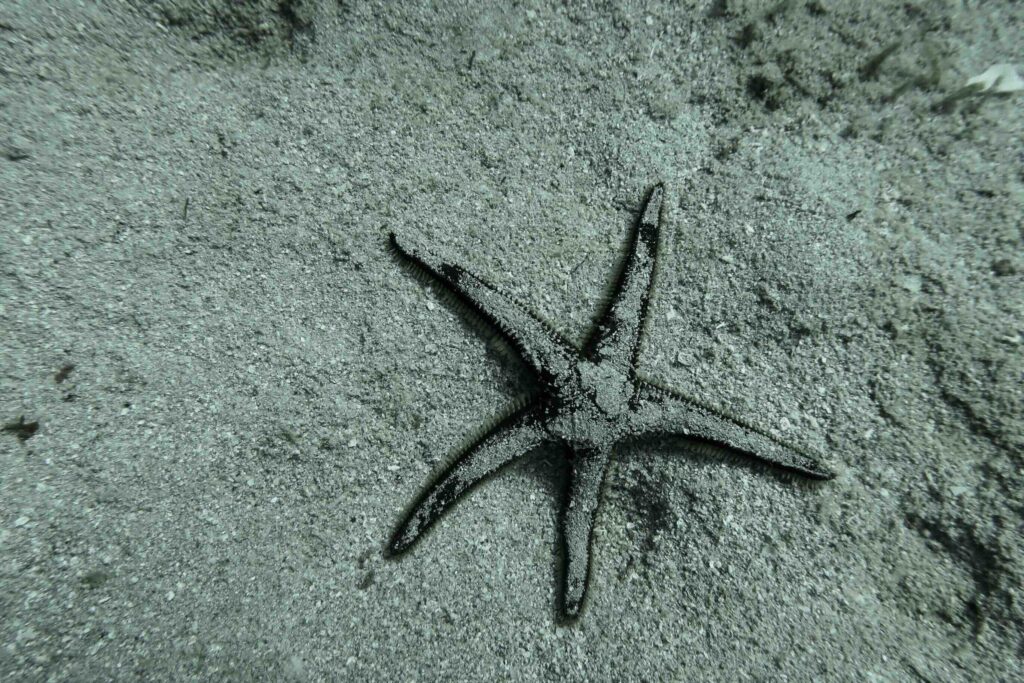
Medium-sized comb starfish (diameter up to 20 cm). Colour ranging from light to dark brown. Arms are thin, elongated. The entire periphery of the starfish is bordered by two rows of white spines.
Geographic distribution. Mainly Mediterranean Sea, also Azores.
(for more infos: https://doris.ffessm.fr/ref/specie/708)
Astropecten platyacanthus (Philippi, 1837) … Most probably!
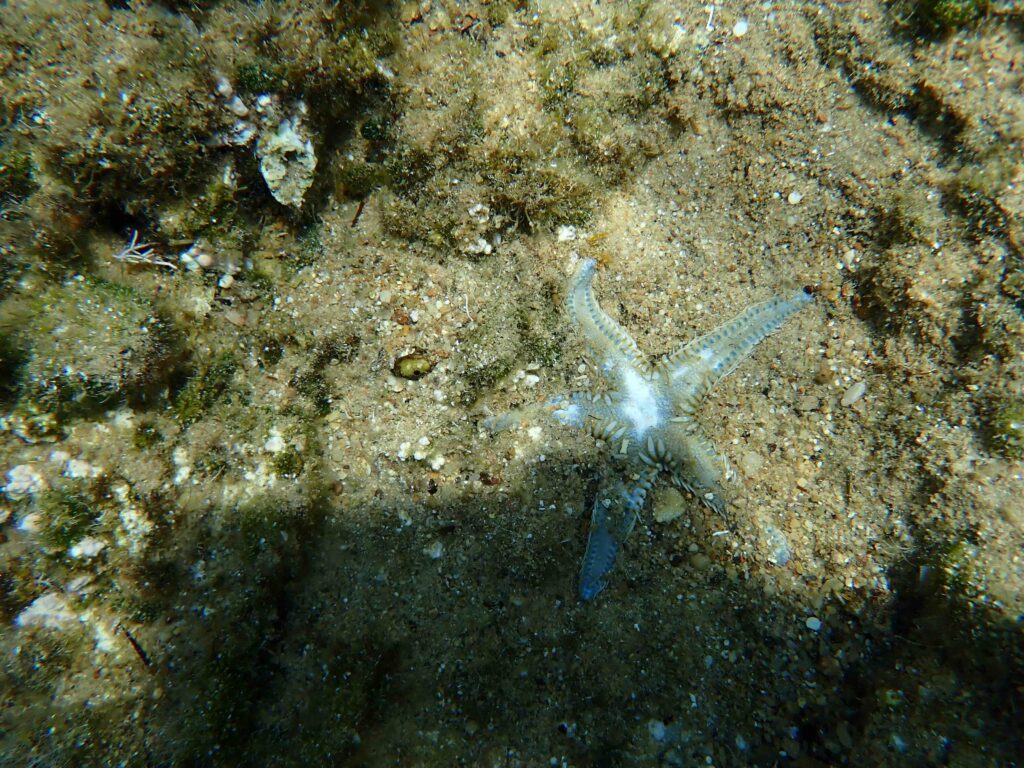
Medium-sized comb starfish (diameter up to 18 cm). Colour usually clear ranging from whitish to greyish or brownish. The lateral face of the marginal plates bear numerous short, blunt spines. This species is often found on coarse detrital sand as illustrated here.
Geographic distribution. Endemic to the Mediterranean Sea
(for more infos: https://doris.ffessm.fr/ref/specie/1882)
The spiny starfish, Marthasterias glacialis (Linnaeus 1758)
Starfish with five strong and quite stiff arms starting from a central disk; each arm bears numerous short (often blunt) spines organised into 3 lines. Spines are surrounded by a mobile fold of skin bearing densely packed pedicellariae (the fold can slide along the spine shaft). The pedicellariae have a defensive and a cleaning role. Colors variable according to individuals (green, grey, yellowish-orange, pinkish, blueish, … The tip of each arm is pink and photosensitive.
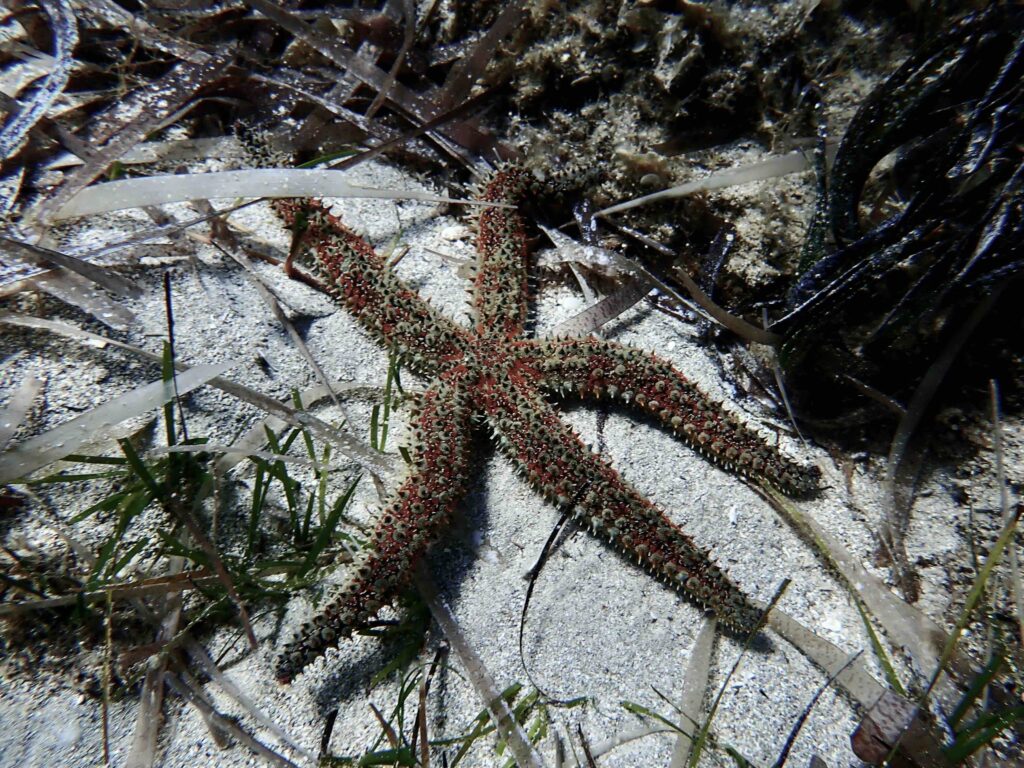
It is an efficient predator feeding on mollusks (bivalves, gastropods), sea urchins, crustaceans, dying fish (or even on dead animals). When feeding on bivalves, it everts its stomach, introduces it between the valves and digests the prey from outside.
Marthasterias glacialis lives in shallow to deep waters (200 m) and occurs on rocky substrates, in cracks or under stones, but also on sandy to coarse sediment. Adults can reach large size (diameter up to 80 cm) but the one observed here is ca. 30 cm.
Geographic distribution. Atlantic from Norway to South Africa (including Cape Verde, Canary and Azores islands), Mediterranean.
Heart sea urchins (Echinoidea)
Heart sea urchins belong to the Spatangoida, a specialized group of irregular sea urchins that adopted a burrowing (infaunal) lifestyle. These irregular sea urchins differ from the regular ones (i.e., the ‘globular shaped’ sea urchins you can easily observe on rocks) in having a depressed body, a bilateral symmetry with an anterior and a posterior extremity, and an unidirectional displacement (anterior extremity first). This led to the specialisation of the spines and tube-feet fulfilling here distinct functions (movements, burrowing, feeding) according to their place on the body.
Heart sea urchins live buried at various depths in the sediment; some can move on the sea floor surface at night. They ingest sediment quite in bulk with its load of detrital organic particles. This organic matter is their main food source (Spatangoids are deposit-feeders). They use specialised digitate tube-feet located around their mouth to pick-up sand grains and detrital particles and to introduce them in their mouth.
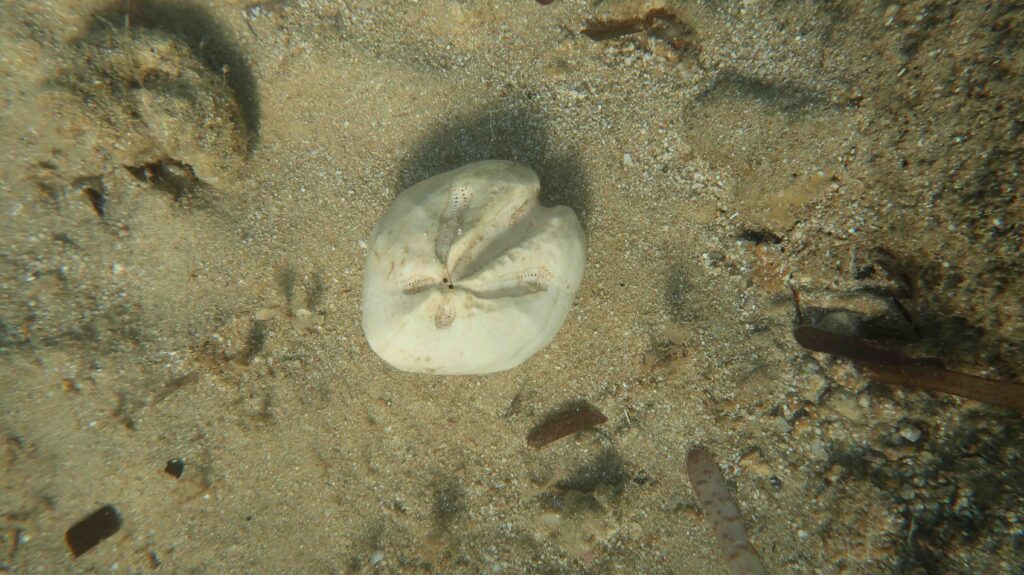

Predators of heart sea urchins are some sea stars (e.g., Astropecten), gastropods, fishes or crustaceans. Tests are often found on sandy bottom. The pictures above illustrate those of Ova canalifera (left) and of Brissus diversicolor (right) found on the seafloor.
Diverse tests of Brissus diversicolor, and a small test of a regular echinoid, Paracentrotus lividus (the rock-urchin or brown sea urchin) are illustrated below to compare their respective symmetry (bilateral vs radial).

Sea cucumbers (Holothuroidea)
‘Sausage-like’, the holothuroids have a cylindrical body, usually a little flattened ‘ventrally’. Along the body length, tube feet are organized into 5 lines: 3 on the ventral side (trivium) and 2 on the dorsal side (bivium). The mouth opens at one extremity being surrounded by a circle of tentacles (large retractile tube-feet), while the cloaca opens at the other extremity (intestine and gonoducts open into the cloaca… there is thus one common opening expelling outside faeces and gametes).
NB: Being rather fleshy and unarmored animals, holothurians look like ideal preys… They defend themselves through different mechanisms: some species eject sticky tubules (Cuvierian tubules) that will entangle the predator, other eviscerate part of their viscera (regenerating them after), some contain chemical toxins.
The brown sea-cucumber, Holothuria stellati, Delle Chiaje 1824
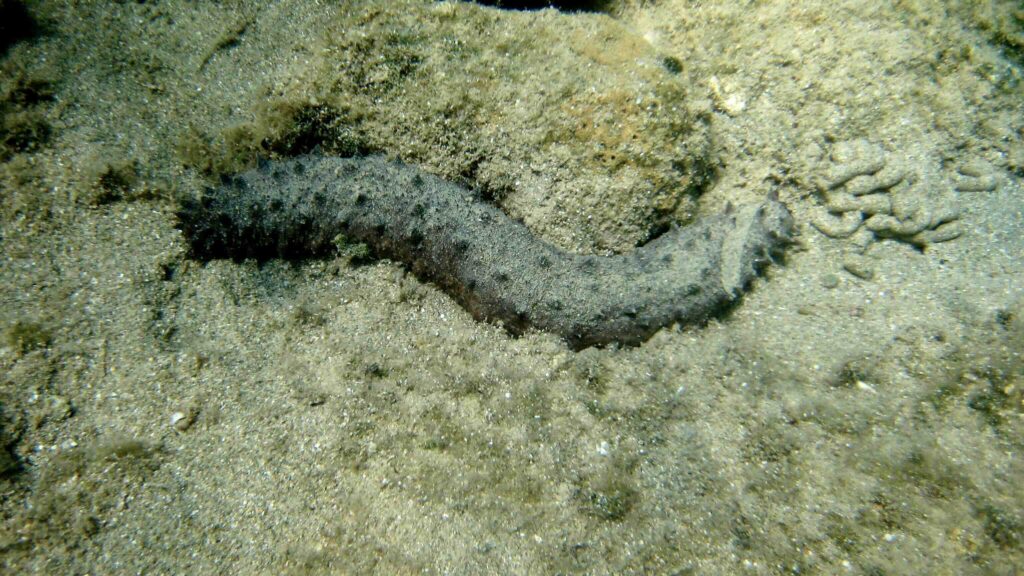
The brown sea-cucumber is frequent on sandy bottom; it ingests sediment and feeds on the associated organic matter. Small cylinders of packed sediment behind the animal are their faeces.
Size of the animals met here in shallow water: 15-25 cm. Colour brownish or darker, almost black. The tegument bears conical papillae.
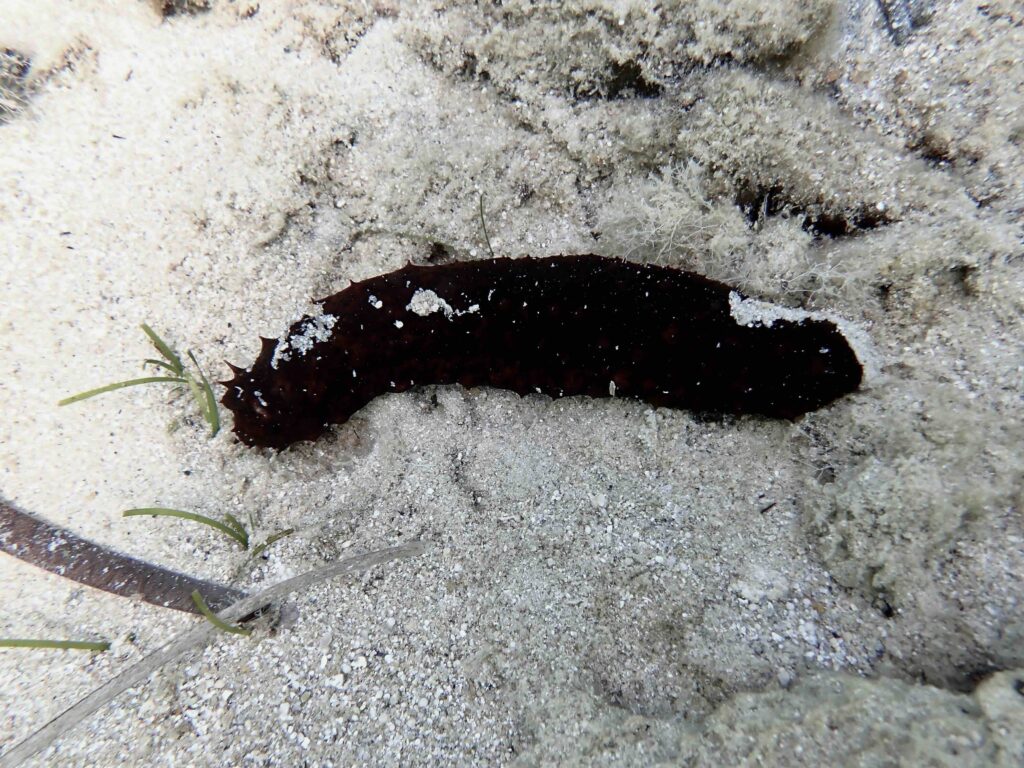
Geographic distribution. Mediterranean Sea. Possibly also Canary Islands.